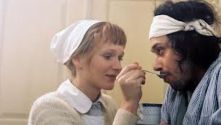
Here is director Jan Svankmajer to introduce his film, one which he tells us is drawn from a story by Edgar Allan Poe but has great pertinence to how we live in the modern world. There are two methods to run a mental asylum, he goes on, one is to let the patients do what they want, and the other is to implement extreme control; these are also valid for running a country, but there is a third way and that is a combination of both. Before he has a chance to muse upon the possibility of a happy medium, Svankmajer is interrupted by a slithering tongue, and leaves us to consider what his work observes...
After that intro, we are plunged into the world of Jean Berlot (Pavel Liska), who as we meet him is suffering delusions, or they may be a simple nightmare, that two burly orderlies are advancing on him with a straitjacket. He causes a commotion in the guest house he's been staying at, and shamed he feels the need to leave the very next morning, but then is invited to the breakfast table of a man known only as The Marquis (Jan Tríska). Can you guess who that is? Nope, not a character from Poe but a real life historical figure, the Marquis de Sade, for he was an additional influence on the film as Svankmajer mixed up "classic" texts to make his points.
Naturally (or unnaturally might be closer to the mark) he also employed his trademark stop motion stylings, continually returning to a series of offal products making their way on the same journey as Jean takes, tongues, eyes, and slices of meat animated on an errand which makes little sense until the very end, and even then might confound you if you're not on the director's wavelength. They did offer some of the most striking imagery here, however, and as usual with his efforts the animation remained the highlight, though some would argue at their best when mounted in the shorter works which came across as less rambling and more punchy, more succinct.
Nevertheless, Svankmajer did hold the attention thanks to his mixture of references and his withering summation of society, in this case linking how the totalitarian regime he had lived under in Czechoslovakia for much of his life related to the extreme control manner of running an asylum, and the alternative where everyone did as they pleased which was just as dangerous in his mind. Then again, if you did create an amalgam of these according to this the results would be chaotic, offering no guidance and simple confusion would arise - you got the impression the now aged director had seen it all, and found everything coming up wanting. This cynicism, even pessimism, bolstered a horror yarn which perhaps did not offer much new as far as narrative went.
To be fair, it was based on stories which had made it to the screen before, as the Sadean rites of blasphemy and perversion Jean spies upon were more expansively elaborated on in Pier Paolo Pasolini's Salò, and the Poe stories had been adapted by Roger Corman in the sixties and more blatantly in Juan López Moctezuma's The Mansion of Madness in the early seventies, to which Lunacy took a very similar tack. Jean ends up in an asylum as the guest of the Marquis where he decides to stay in order to save one of the nurses, Charlotte (Anna Gieslerová), who he believes is being held there against her will in this dangerously laissez-faire environment. But is she? The Marquis seems to think she belongs there as much as anyone as a parade of strangeness passes before us, neatly sidestepping the usual "who is the real madman?" clichés to take on the issues of a now unwieldy society at large. That said, if it was the weirdness you were here for and not the message, there was enough of that here to sate your jaded palate.