Three cowboys on horseback ride across the plains until they reach a cliff overlooking the ocean and catch sight of a surfer there, whereupon one of them takes aim with his rifle and shoots him, allowing his spirit to leave his body and drift away. Meanwhile Pat Hartley (as herself) travels from the United States mainland where she is feeling unsettled to the state of Hawaii and a commune there, a place she can hang out and discuss some of the pressing issues of the day, and indeed the pressing issues of eternity as she seeks consciousness expansion...
Oh, and Jimi Hendrix shows up too, but it would be a long wait if that's the reason you were watching Rainbow Bridge. This was a drama documentary, scripted after a fashion, and directed by Andy Warhol alumnus Chuck Wein who put the work he had learned at The Factory into this rather impenetrable exploration of the hippie ideal, when the counterculture was a place where such eccentricity in thought could be entertaining rather than the paranoid hell it became as the decades rolled by. In this case, you might be lost as the cultural dropouts ramble on, but it was oddly amusing to hear them witter away with a straight face about space brothers and whatnot.
Most of these conversations were staged for the camera, but that didn't mean the participants were any the less sincere, though Hartley herself injects a wry quality to her scenes which suggested she wasn't quite convinced by all the paraphernalia going on around here, but was keen to give it a try nonetheless. She was a good choice as the entry point into this world, though after a while, once we've reached the Rainbow Bridge estate, it did feel as if one opaque talkfest after another was going on, with only brief respites for nude swimming or the odd sketch, one of which Hendrix was roped into as he played a lone gunman assassinating an ecologist whose speech went on too long.
Obviously created to spark debate, this was in touch with the spiritual side of life, though organised religion wasn't its bag - Christians are given short shrift at the beginning - as it preferred taking hallucinogens to open up grand vistas of imagination, though from what we hear these experiences sound like material from your average contemporary science fiction paperbacks rather than something worth changing your life over. Mixed in with talk about space aliens are conspiracy motifs which posit, say, the energy companies have access to unlimited electricity, a state of affairs which can be solved when we finally discover the truth about how far beings from other worlds have influenced our planet's society. As long as the government doesn't put fluoride in the water supply, of course.
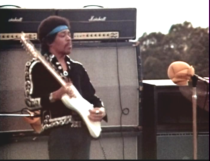
But it would be Jimi Hendrix who was the main attraction, as if Wein was using the performer as a lure to draw in audiences who would not ordinarily have access to the big ideas contained within, a ploy which continues to succeed all this time later. We do get to hear Jimi in conversation, which sadly proves as unilluminating as the rest of the movie if you're not on its wavelength (there are ways and means to solve that problem), mainly because the rock legend is utterly stoned and doesn't even seem to know what he's saying himself never mind putting it across to us watching, particluarly if you're stone cold sober. The concert itself took place on the side of a Hawaiian volcano (not while it was erupting, I hasten to add) and lasts about twenty minutes, not Hendrix's finest appearance on film but no matter how out of sync the images are with the sound, it's still recognisably him playing his guitar. This was ramshackle, but strangely engaging in its painfully earnest manner.