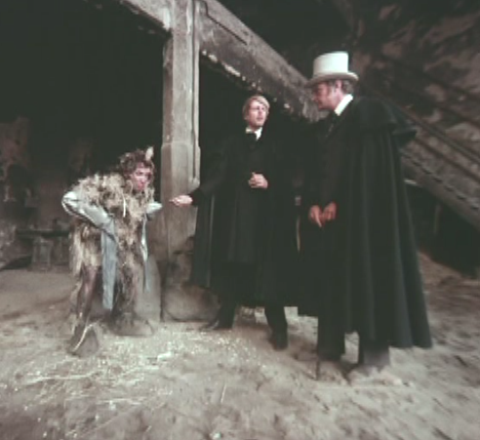
Gaston LeBlanc (Arthur Hansel) is a journalist who has convinced his editor to allow him to venture out into the remote French countryside to visit an asylum for the insane where he has heard intriguing things about the methods of its head doctor, Maillard (Claudio Brook). He is travelling by stagecoach with his friend Julien (Martin LaSalle) and his cousin, who doesn't seem to be very well as she keeps nodding off, but soon they have something else to worry about as the forest road is blocked by branches. The very strong coachman lifts them out of the way - then they notice the men with guns.
The Mansion of Madness was the directorial debut of Mexican surrealist Juan López Moctezuma, but it was not his first involvement with film, as he was a great friend and associate of the more famous Alejandro Jodorowsky, and had produced both that talent's Fando y Lis and his celebrated cult epic El Topo. Nevertheless, he felt the need to strike out on his own, and this loose adaptation of an Edgar Allan Poe story was the result, though it seemed as much influenced by two British efforts, Peter Brook's staging of the Marat/Sade play combined with Ken Russell's version of The Devils. So if you had watched those, Moctezuma's work here might appear on the second hand side.
Not helping its reputation was that the easiest way to see this was in a poor quality public domain print renamed Dr Tarr's Torture Dungeon, which had been a little trimmed, though oddly its dubbing into English was accurate for the director had shot it that way, rather than in Spanish as its native country might have dictated. But in the main he was aiming for a sense of delirium which he achieved to an extent, leaving the plot loose in the face of a succession of scenes where the cast would act strangely and Gaston would express his displeasure, all leading up to an inevitable showdown between him and Dr Maillard, who was not all he appeared to be - though given his propensity for laughing manically you could have guessed that.
This was essentially one of those "lunatics have taken over the asylum" tales where the horror sprang from the notion of mental instability given full rein, though unlike some variations on this theme the threat to Gaston and his companions is wholly external, so we never fear for the sanity of them, we simply fear for the insanity of the inmates. Early on, he suspects all is not right in the mansion as Maillard offers him the guided tour, unaware Julien has been tied up by the "guards" outside and the cousin has been raped, but given more than an inkling the doc's cures are nothing more than encouragement to the patients' worst excesses. This includes a chap called Mr Chicken, who acts and dresses like said fowl, eating corn out of his master's hand.
As you can imagine, there was a strong element of the theatrical to Moctezuma's imagery in light of his grounding in that tradition, so you could see much of the craziness occurred here as a translation of the sort of in your face, confrontational productions best kept to fringe theatre efforts. Not to say The Mansion of Madness was unenjoyable, it's just that it didn't really have the insight to pull its concepts off, leaving after a while a parade of the weirdest antics the director could conjure up, and the narrative, for all its bizarre setpieces, was very much the stuff of many a horror movie seen before and since. Basically, get in there, save the innocents at the mercy of the twisted doctor - the patients are too far gone, frankly - and see to it that he doesn't do it again, though as it turns out Gaston's enthusiasm for a fistfight with him is scuppered at the end. Funnily enough, this bore quite some comparison to Grant Morrison and Dave McKean's Batman graphic novel for adults, Arkham Asylum. Music by Nacho Méndez.