A man goes to market and notices a conjurer nearby, so he follows the crowd and marvels at his tricks, then joins in with the lottery the magician has arranged, eventually winning his own chicken. Very pleased, the man takes it home to his wife who is equally satisfied, but when the chicken lays a huge egg, they don't know what to think, that is until they crack it open and out spills a collection of gold coins. Now they think they will be rich, and greed overcomes them - and also a couple of scheming thieves in the vicinity...
Based on the famous European fairy tale and subsequent proverb about not killing the hen that lays the golden eggs, this was an early production from the French studio Pathé, one of their most popular or certainly one of their most heavily promoted. By this stage films were beginning to move past their novelty value and had turned into a mass market entertainment, though still at this point in time were running ten to fifteen minutes long, not having grasped the concept of an epic, or even one which lasted over an hour.
Still, the public lapped them up, and tellings of folk tales or classics were what most wanted to see, with exceptions as comedy was taking hold: presumably if you could combine the lot then you'd have a moneymaker on your hands. In this case, there was fantasy, humour, dance and a moral lesson to be imparted about not being too miserly or avaricious, nothing too heavy but enough to offer the audience the idea they had been improved by watching it. The film included one of the earliest appearances by one of the first movie stars, for Julienne Mathieu was often used by Pathé, for about ten years at any rate, because the punters recognised and liked to see her.
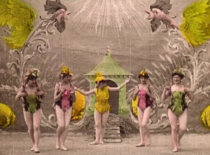
To render these shorts more attractive to the eye, the black and white images were hand painted, not often completely, but as seen here with a part of the frame highlighted, whether it be a costume or the gold itself, offering a more magical proposition for a night out at the cinematograph. To add to such ornamentation were special effects, obviously of the stop the camera, change something, start the camera again variety which was early film's stock in trade when it came to effects, but also elaborate for their day stagings as huge eyes staring enviously at the man's hoard as he hallucinates in his money mania, or the thieves looking into one of the eggs and seeing the face of the Devil himself, actually an animated drawing. We even see, for no good reason other than entertainment (which is reason enough), the chicken and her friends turn into dancers, and if this is primitive then it does charm in its antique fashion.
[This and over thirty shorts like it is available on the BFI's Region 2 DVD Fairy Tales: Early Colour Stencil Films from Pathé, which include newly composed soundtracks and an informative booklet. A must for silent cinema fans.]