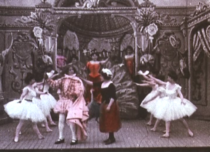
Faust comes home one day in a state of depression, and though his sweetheart offers him food to eat nothing will shake the gloom. Until, that is, the Devil himself appears before him and tempts him with his heart's desire, and even a few things he never knew his heart desired, all in return for his soul. Faust doesn't need asking twice, and soon has signed a contract which immediately sees his sweetheart forgotten about and the man set down in a series of seven castles where he can live it up - but at what cost?
Ferdinand Zecca, the director of this, was the main man for the French production company Pathé, helming many of their popular efforts and in his day a rival to the better known Georges Méliès. Watching this, one of his first major works, you can see why he has not endured in the imagination as much as that genius of early silent cinema, as where Méliès was endlessly innovative and can still delight an interested audience over a hundred years later, this really does look very creaky, though that was not to say there was an utter lack of entertainment value, it's just that Zecca seemed like the also-ran he was.
Here the classical tale of Faust gets a relatively lavish treatment, all shot on stages so if it were not for the camera effects it would resemble a filmed play even more than it did. These days when such works look so ancient in comparison with what we have now, the interest lies as much in seeing a window into the past as it does with the story, and as this was a pretty hackneyed yarn back then, never mind now, the historical fascination has probably overtaken the original message and enjoyment value. At just eleven minutes long, it races through the plot to get to its hero's redemption, although we haven't witnessed much to indicate he actually deserved it.
Not Faust's fault, but the devotion of his sweetheart has to take it as read that he's worth salvation on the part of the audience, such was the compressed time we were operating with - feature length movies were still a while away. Each of the castles represents one of the seven deadly sins, helpfully pointed out to us in multilingual signs dotted around the sets, so in one scene Faust will be lavished with gold, the next with women, and then with vast amounts of food, the overloading of his senses in each showing he should have been satisfied with a decent moderation. There were amusing items in each of these scenes, but what really takes the biscuit - and any other comestibles going - would be the giant head which dominates the gluttony sequence, eating away until it starts to consume the serving boys and chefs! Whether you'll take its lessons on board is up to you, though the threat of Hell remains if you don't.
[This and over thirty shorts like it is available on the BFI's Region 2 DVD Fairy Tales: Early Colour Stencil Films from Pathé, which include newly composed soundtracks and an informative booklet. A must for silent cinema fans.]