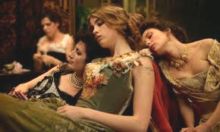
Nothing divides Britain from France and much of mainland Europe quite like our respective attitudes towards sex. Little wonder then that House of Tolerance, or L’Appolinide (Souvenirs de la maison close) as it is known in France, a title inspired by the scandalous painting of the same name by Gustave Courbet, director Bertrand Bonello’s darkly poetic account of life inside a 19th century Parisian brothel, was alternately praised in its homeland whilst widely reviled on these shores. The film opens during the last days of the year 1899, as prostitute Madeleine (Alice Barnole) recounts an unsettling dream she had about a regular client whilst the young man himself listens intently. Thereafter Bonello segues into the almost genteel interaction between an ensemble of scantily-clad courtesans and their well-heeled clientele, be they young libertines, dirty old men or elegant sadists. Suddenly, we are jolted out of our complacency with a shock cut to a screaming Madeleine, tied to a bed, covered in blood. Her young client has inexplicably slashed her face with a razor, carving a grotesque smile that lingers therafter upon her tragic visage.
Things jump abruptly forward to 1900 where sixteen year old Pauline (Iliana Zabeth) arrives at the brothel. Armed with a letter of recommendation from her parents (!), Pauline believes the upscale brothel offers the kind of freedom a young woman would not find in the outside world as well as the chance to earn a nice living. Frankly, Pauline proves something of an enigma. On paper she reads like your classic wide-eyed ingenue due for a rude awakening, yet proves surprisingly worldly and jaded before her time. Far from our focal point character, she slips in and out of the narrative, learning the ropes from the other girls who all welcome her warmly, asking questions that seem to be leading somewhere but don’t really, and servicing clients with neither problems nor complaint. Midway through Pauline coolly exits the film upon learning an increase in the rent means Madame has to sell the house and even her newfound friends have no idea where she has gone.
With no central character to speak of, Bonello crafts an episodic narrative that attempts a claustrophobic yet panoramic view, examining the girls’ daily hygiene regimen, the rules they live by, shared moments of cameraderie laughing about the clients, and their dreams. Some are resigned to their bleak lives while others yearn to escape though even these dreams are tainted with cynicism. Julie (Jasmine Trinca) is in love with an elderly client who abandons her when she contracts syphillis. At twenty-eight, Clotilde (Céline Sallette) realises she is growing too old for this job and, having all but abandoned hope her lover will ever take her away from all this, seeks solace in the opium pipe. Meanwhile, Madeleine retreats into menial duties till she discovers deformity has made her desirable among the brothel’s more decadent clientele and ventures into the freaky sex circuit.
Exquisitely photographed by Bonello’s wife and regular D.P. Josée Deshaies, the film’s tone could be best surmised as glam-but-glum resignation. Neither romantic nor necessarily jaded, nevertheless none of the ladies harbour any delusions about why they do what they do. Bonello incorporates an array of deliberately distancing devices: an anachronistic soundtrack that mixes classical with vintage soul along with The Moody Blues performing “Nights in White Satin”, the repeated use of split-screen showing four seperate actions, and credits with glamourized images akin to the art-porn photography of Helmut Newton. We sense he is trying to provoke viewers but does he really need to? The history of the sex trade actually reveals a great deal about our society, but Bonello does not shine a light on any substantial revelations here.
In fact, for all the undraped French starlets on view, sex is not subject matter. Rather it is the suggestion that at this point in time, prostitution offered a form of freedom unavailable elsewhere for young women, albeit at a heavy price. But even this comes across more muddled than profound, largely by result of Bonello’s presentation which is oblique to the point of impenetrable. There are the occasional affecting moments, as when Samira (Hafsia Herzi) breaks down in tears upon reading a feminist scientist’s claim only women that are genetically inferior choose to be prostitutes, and a memorably strange scene wherein Léa (Adele Haenel) delights a client by performing as a clockwork doll (a brilliant piece of mime by Haenel) that recalls a similar sequence in Fellini Casanova (1976), while the climactic descent into surreal horror that includes a masked orgy even more joyless and creepy than the one featured in Eyes Wide Shut (1999) would be more effective were it not so damn vague. The present day coda which features one character seemingly reincarnated as a modern streetwalker, implies the sex trade would be far less bleak were licensed brothels still available in Paris, but what lingers most is Lea’s haunting lament: “If I ever get out of here, I’ll never make love again.” Which says it all, really.