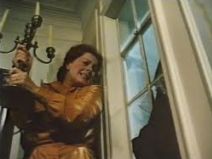
Brittle-nerved Fanny Pierce (Jeanne Crain) is unhappy her preacher husband (Alex Nicol) has wasted both their lives failing to save any souls in the crime-ridden inner city. Seeking a fresh start the pair head out to the country, only to fall afoul of a cult of crazed Christian hippies led by Billy Joe Harlan (Michael Sugich), a self-righteous loon with messianic delusions. Hiding helpless in the dark, Mrs. Pierce watches Billy Joe and his disciples crucify her husband on his own cross. Found guilty of murder and sentenced to death, Billy Joe swears vengence on Mrs. Pierce. Shortly thereafter, the judge trying the case hires Mrs. Pierce to babysit his unruly teenage kids: Sharon (Dawn Cleary), Nancy (Barbara Hancock), Jimmy (Gary Morgan) and obnoxious elder brother Peter (Dan Spelling). As night falls, Mrs. Pierce receives threatening phone calls after which the teenagers notice sinister figures lurking outside in the dark.
Joan Crawford and Bette Davis paved the way with Whatever Happened to Baby Jane? (1962) and by the early Seventies almost every fading Forties film siren had graced a horror movie. The Night God Screamed was just such a vehicle for the lovely Jeanne Crain, a long way away from such charming Technicolor whimsies as State Fair (1945) and Margie (1946) although she had a notable supporting role in the far darker Leave Her to Heaven (1945) and, four years earlier, appeared in the exploitation film Hot Rods to Hell (1967). Crain acquits herself well as a dour, paranoid woman far removed from her glamorous norm. Hyperbolic title aside, director Lee Madden shuns overt bloodshed yet conjures a palpably eerie mood, staging some creepy set-pieces and making fine use of Stevan Larner’s shadowy cinematography aided by a scary electronic score. Co-written by Gil Lasky along with one of the film’s stars, Dan Spelling, brother of legendary trash TV mogul Aaron Spelling, the plot hinges on whether the house is really under siege or if it is all happening inside Mrs. Pierce’s guilt-ridden mind, tortured by her failure to save her husband and, it is implied, secret relief at escaping an unhappy marriage. Yet though the film poses tantalising questions, the answers it settles for prove gimmicky and confused.
Among several twists is the novel concept that rather than the ranting Satanists usually cast as horror movie villains, this film’s crazed cultists are fanatical Christian hippies with Billy Joe Harlan (wildly overplayed by Michael Sugich) evidently fancying himself a latter day Jesus. In the interest of fair disclosure, this writer is a practicing Christian, something which undoubtedly colours my opinion of the film. Maybe this is how pagans feel while watching The Wicker Man (1973) take pot shots at their religion. Tellingly the film casts a youthful, seemingly liberal, multiracial religious wing as the embodiment of evil whilst upholding the more rigid, dictatorial incarnation of the church. Though, like many horror films of this period, largely influenced by the Charles Manson murders, the plot is possibly prescient given later events involving the Reverend Jim Jones, yet the opening sequence betrays its real reactionary agenda.
After a shock intro where Billy Joe drowns a doubter (“This chick is a Judas!”), we follow Crain’s haughty heroine as she wanders the city. “Everything is ugly”, she thinks to herself as Madden casts Crain as a symbolic presence, an emblem of all that was once glowing and good now mired in amorality, degradation and decay as a result of no-good punk kids. For while a prosecution attorney labels Billy Joe a perverter of the genuinely positive religious resurgence in young people and Judge Coogan (Stewart Bradley) describes his children as the squeaky-clean exception to the norm, the clear absence of any single positive young person in the film leaves it clear what side of the divide Madden, Lasky and Spelling are on. The underlining message is the world would be a far better place if young people did as they are told, not what they want. It is a despairing, misanthropic, frankly rather depressing film, skilfully suspenseful in parts yet ridden with logic holes.