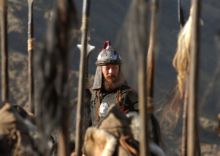
During the 12th Century one man commanded around half the world, and he was Genghis Khan (Tadanobu Asano), but how did he reach such a position of enormous power? Let us step back in time to the early years of his life when he was nine years old: his ruling father the Khan had taken him, then named Temujin, to a village he owed something to so that they could pick out a wife for him. When he was there the boy got to chatting with a girl there, Borte, so when it came time to choose, she was his preferred option. They would not meet again for years...
Just as there was a trend for movie versions of well known characters to depict the origins of those adventures, so it was Russian director Sergei Bordov did the same with one of the most notorious figures of history. It was his plan to make a series of films, two or three, showing Genghis at various stages in his life, so naturally he began at the beginning, or at least as much as he could for the actual details of the subject's life at that point are rather murky. The historians were wont to throw up their hands at the inaccuracies, but this was more a sweeping historical epic in the vein of something Hollywood might have done with the material.
Casting a variety of nationalities, Bordov and his team set out to craft a personal but spectacular piece of storytelling, complete with grand vistas of Mongolian plains and landscape for that authentic flavour, though oddly this was not so much a Mongolian movie as it was a Kazakhstani movie; there were a few countries involved, and this feeling of too many cooks never quite left the results. It took over a year to make such was the director's dedication, and the remote areas he shot in offered an appearance that not many similar epics could boast, but for all that it didn't look so much immersive as glossy and slick, which for the tale of a down and dirty conqueror didn't gel.
Not helping was in this telling Temujin spent most of the first half hour wandering about in stocks, having been captured at least twice by the enemies of his father, who has been bumped off with poison in the opening ten minutes or so. The boy, then man, is the rightful heir to his land and subjects, but we have a lot of intrigue where Temujin has to work out a way of gaining allies to his cause, though Asano plays it rather blankly, as if unsure whether to go for man of the people or imposing warrior, and settling on making us wonder if this immensely significant leader should be a lot more charismatic than the actor has made him - there's more than once you'll see him outacted by the scenery.
With so much of the story conjecture, it's best not to worry about what was accurate and what wasn't and appreciate it as a rise to fame yarn, as the future Genghis suffers such trials as losing the now adult Borte (Khulan Chuluun) while she's pregnant with his child - she doesn't wander off or die or anything, she gets kidnapped by a bunch of mask-wearing tribesmen, so Temujin must persuade his brother Jamukha (Sun Honglei) to assist in rescuing her. Basic adventure stuff really, and wouldn't look out of place in the John Wayne turkey The Conqueror, except this is more visually accomplished, though when Sun shares the screen with Asano you notice he has the magnetism that would have made a far more interesting Genghis Khan than the actor they cast. If you were seeking a Mongolian blockbuster that rang true with the culture and the history, sadly this film came up lacking, with an international feel that would have been better served with more local character. Music by Tuomas Kantelinen.