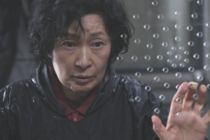
Yoon Do-joon (Won Bin) has learning difficulties, so he is looked after by is mother (Kim Hye-ja) who dotes over him to the extent they even share the same bed at night, just as they did when he was a child. Today there's an accident where Do-joon is clipped by a speeding car outside his mother's herbalist medicine shop, and on witnessing the accident she nicks her finger on her guillotine, but before she has the chance to see if her son is all right, he rushes off with his friend Jin-tae (Jin Goo) after the offending vehicle, heading for the golf course...
Whereupon they both get into an altercation with the driver and his associates which lands them in the police station, and not for the last time as Bong Joon-ho allowed his suspense drama to play out in a fashion that might not have been obvious from the beginning. This has nothing to do with the golfer, and everything to do with Do-joon's reaction when he's insulted by being called a "retard": basically he throws himself at the person trying to wind him up in an act of supposed self-defence; presumably if his mother had taught him to laugh off the taunts we would be watching a very different tale indeed.
As it was, soon the young man found himself at the centre of a murder investigation, though precisely what happened that fateful night is kept a secret from us in the audience and most of the characters for that matter, at least until the final act where all is revealed and the extent of the tragedy is intended to hit home. A lot of that depended on whether you were willing to go along with the director's idea of a twist, which while it was certainly fair enough as far as the narative build-up was concerned, may not have gone the way you would have wanted, certainly for the preceding hour and a half which cast the mother as some kind of South Korean Miss Marple, undertaking her own personal investigation.
All to clear her son's name, yet the more she finds out the more she begins to wonder how innocent any of the locals are around here as a murky plot of corruption and deception is uncovered by her searching. What has happened is that Do-joon was the last person seen following the victim, a teenage schoolgirl, and a golf ball he had taken from the course with his name written on it (by himself) was found next to the body. It doesn't look good for him, especially as his memory is none too clear at the best of times, but is this gentle soul capable of murder, or are we guilty of seeing him through his mother's adoring eyes? While the police pretty much fool him into signing a confession, his mother is not going to take that lying down.
The trouble is, there are too many suspects as she ploughs ahead and sees the unlovely underbelly of her community for what it is, with addiction, sexual exploitation and violence never too far away. But then, as she has told her son to try and recall as much as possible while in prison awaiting sentencing, she remembers she is not too pure herself, as one of the things he brings to mind is when he was a five-year-old when she tried to murder him and kill herself by drinking weedkiller. Obviously they survived, but she did this because she couldn't cope anymore being a single mother and destitute before her line in herbalist remedies and acupuncture, though the implication is Do-joon is mentally disabled thanks to this action in his childhood. From there it's a short step to Bong pointing an accusing finger at motherhood, exposing it here as selfish and capable of dreadful acts thanks to its blind, possibly misguided love. For all the heartfelt (or was it phoney?) emotion it tried to elicit, Mother was a sour film, disillusioned and fatally downbeat. Music by Lee Byung-woo.