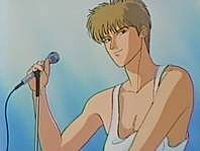
To-Y Fuji (voiced by Kaneto Shiozawa), charismatic leader of the up-and-coming J-rock band GASP, has an intense rivalry with popstar Yoji Aikawa (Naoya Uchida) that flares into a punch-up when the latter gatecrashes their latest gig. To-Y escapes the ensuing media circus alongside an adoring, cat-obsessed female fan named Niya (Nokko), who shares his bed along with his pop idol girlfriend, Sonoko (Mitsuki Yayoi). Sonoko believes GASP are ready to leap onto the next level of superstardom and puts a good word in with her manager, Miss Kato (Rumi Ichiyanagi). But the ambitious Kato tries to convince To-Y to go solo so she can manage his career, driving a wedge with the band and fuelling his feud with Yoji for her own ends.
A lesser known but significant film from the golden age of anime, To-Y is another reminder that the genre has much more to offer besides rampaging giant robots, magical schoolgirls, tentacle porn or cyberpunk splatter. Adopting a style midway between a pumped-up music video and a quirky, character-driven indie drama, the film might be set in the music industry but poses questions applicable to any artistic endeavour. Our protagonist is caught in that age-old artistic dilemma, torn between integrity and the allure of showbiz success. Some chose to interpret the story as an allegory for the state of the anime industry itself which by the late-Eighties had begun to shift away from an auteur-spawned legitimate film movement into an increasingly corporate controlled, multi-million yen behemoth. There were some filmmakers and fans who felt anime had sacrificed at least a portion of its soul along the way, though given the achievements that were yet to come such worries might have been overblown.
Scripted by Izo Hashimoto, back when he was an in-demand screen adapter of ambitious manga like Akira (1988) rather than the director of such sadistic splatter films as Bloody Fragments on a White Wall (1989) and Evil Dead Trap 2 (1991), and based on a popular manga by Atsushi Kamijo, the plot unfolds in an accessible if admittedly freeform style mixing pseudo-existential drama, cutesy comedy and MTV-styled musical sequences featuring some of the hottest J-pop acts of the day. For an Eighties anime, To-Y earned a surprising degree of credibility amidst the Japanese music scene, largely because its musical supervisor was one Masayuki Matsura, member of the hit band PSY-S who contributed several songs to the soundtrack along with such artists as Street Sliders, Barbee Boys and Zelda.
Mamoru Hamazu had a somewhat eclectic career in anime. His best known work in the west would be the homoerotic sword and sorcery serial The Heroic Legend of Arslan (1991) which was widely released in the UK in the Nineties. Though he was a staple of more conventional children’s fantasy epics, from Ronin Warriors (1989) to B’t X (1996), and made the CLAMP-scripted Miyuki-Chan in Wonderland (1995), a kinky S&M parody of Alice in Wonderland, Hamazu showed a knack for delicate character studies of young people as shown by his likeable sports-themed romantic comedy Blue Butterfly Fish (1993).
While To-Y certainly touches the issue of corporate rock’s threat to legitimate youth culture, the often obtuse storytelling favoured by Hamazu leaves it occasionally hard to discern whether the film is really serious about its themes or aimed largely at teenage girls looking for male eye candy with a catchy soundtrack. For one thing, the film fumbles a strange subplot involving To-Y’s Robert Smith lookalike, switchblade wielding friend lurking on the fringes of the narrative who seems set up to be a Mark Chapman-like assassin, though that never quite happens. The conclusion is genuinely heartening but suspicion lingers that the film’s champions are reading more into the narrative than is really there. Interestingly, in the Nineties a San Diego anime fan club re-dubbed the film, transposing its setting from Japan in the bubble economy Eighties to grunge rock-era Seattle, shifting the plot into a Kurt Cobain allegory.