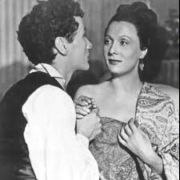
During the 1820s in Paris, a part time actress and general woman about town Garance (Arletty) is accosted in the theatre district of the city where she tends to spend her time. The man who has stopped her is Frédérick Lemaître (Pierre Brasseur), who is something of a performer himself and a show off with it who is well aware of his charm, thus takes every opportunity to deploy it. She is amused by his patter but soon walks away, and even though he moves onto another attractive woman Garance stays in his mind - but she has this effect on men, which will lead to terrible heartache for too many people...
Something else which was the cause of terrible heartache was World War II, and although the scale of the real life conflict and the one in this story were vastly different, it was the parallels between them both director Marcel Carné and his screenwriter Jacques Prévert wanted contemporary audiences to take away. For Les Enfants du Paradis was created under great pressure from the Nazi Occupation in France, and was every bit as complicated in its production as the eventual fingers of blame pointing once the liberation had occurred would turn out to be. That Arletty, the star of the most famous artistic challenge to the oppression would be arrested as a collaborator, was one of many ironies.
But if you took Carné's side (he was also accused of collaboration), the you could see his film as a celebration of the French spirit and the liberté they held so dear, which had been temporarily taken away from them by the invading enemy forces. Naturally he couldn't make a film about the Occupation outright, so opted to thread his historical narrative - based around various bits and pieces of the past rather than any one true account - with signs to the audience that France was going to endure well past the point the Nazis had been sent packing, and sat on the release for a while to ensure it made it to cinemas once the Liberation had happened. For this reason it's a film very dear to the hearts of France, yet as the years go by and the sense of allegory is eroded, some do not see the same lustre as it once had.
In that way Les Enfants du Paradis was like other "Greatest Films Ever Made" such as Citizen Kane, labouring under the yoke of the classic label which for many made it offputting and reluctant to tackle it, and if they did then satisfied that it did nothing for them. It's true that for a film that runs over three hours, it makes demands that its lack of a happy ending, or at least one which resolves it plot, does not entirely reward, and Arletty was by this time in her forties and possibly too old to convince as a woman who encapsulated the best aspects of Paris to render her irresistable to the opposite sex. Also, there's the mime. One of her suitors is the lovelorn Baptiste (Jean-Louis Barrault), a Pierrot figure who often takes to the stage to act out comedy and tragedy silently: mimes have not had good press over the intervening years, and not everyone is going to appreciate the form.
And yet, and yet, for all its flaws and the production story with its intrigue, danger, grief and triumph which was for many even more interesting than the film, what with Carné's close working with the Resistance and walking a tightrope with the murderous authorities (the name of the main theatre here translates as "The Tightrope"), every so often you're watching Garance rejecting one suitor, or them fumbling their big chance with her, and there's a beautiful line of poetry in the dialogue, or an example of ornate design which you can hardly believe was achieved under the circumstances. For all its themes of eternal romantic dissatisfaction - feel sorry for Nathalie (María Casares) whose unrequited love for Baptiste looks to be finally won until he hears Garance is back in town - it was the scenes of rejoicing that stuck with you, and it is a film which like it or not has a way of leaving traces in the mind. The way it ends in a massive street party just as the final blow of heartbreak lands illustrated its contrasts and richness, as well as the mixed feelings it contemplated with sad-eyed insight. Music by Maurice Thiriet.
[Second Sight have released this on pristine-looking Blu-ray with various featurettes as extras.]