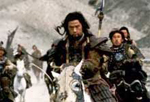
14th century China. A group of Korean envoys find their diplomatic mission cut short when they are accused of spying by the Ming emperor.Their fate – exile in the cruel, unforgiving desert – looks to be irreversible until they elect to rescue an abducted Ming princess in the hope that a grateful emperor will grant clemency.
With over five years of pre-production and meticulous eye for period detail, The Warrior finally hit the ground running when it exploded onto theatre screens as one of the biggest and best films in Korean cinema history. Director Sung-su Kim's epic production has been hailed as a stylised marriage of East and West: think Akira Kurosawa meets David Lean. You can also add colourful trad sets straight out of the Shaw Brothers world, and throw in a quartet of the most amazing battle scenes where arms, feet and hands are lopped off, spears hit their targets with unerring accuracy (usually, straight above the eyes) and there's one 'Can't- believe- I- saw- that' moment involving an outrageous decapitation.
Throughout its 127 min running time, The Warrior never outstays its welcome, setting out markers for heroes and villains amongst the fine cast, while slowly invading one's conciousness to ultimately declare there are no lines seperating good and bad in this film. Ziyi Zhang (Crouching Tiger, Hero) will be the most famous name and face – at least, to Western audiences – and she delivers an admirable performance here as princess Furong, though the limelight is unquestionably stolen by Sung-Ke Ahm's heroic older statesman; Woo-sung Jung's spear-wielding slave-turned-warrior, and Jin-mo Joo's turn as General Choi Jung, the film's most complex character.
Those yet to dip a toe into the waters of Korean cinema will likely find this a bracing introduction, and Premier Asia's Region 2 DVD will enrich the experience with a host of supplementary features. First up is a commentary track, where Bey Logan and Mike Leeder join forces to guide us through the careers of cast and crew, while also delivering a potted history of Korean cinema. We learn about the art of casting; the 'new wave' of Korean filmmakers; the current trend for actors to mix film with theatrical productions, and why The Warrior received mixed reviews despite its refusal to underestimate the integrity of its audience. While neither Logan nor Leeder adopt the scene-specific approach, both are ready, willing and able to highlight mood and motivation during several key character development scenes, and dispaly immense knowledge of their subject matter - both in front of and behind the camera.
The second disc begins with 'Inside The Warrior', a 56 minute making-of, containing interviews with director Sung-su Kim and several members of cast and crew, together with sections on make-up and special fx. Sung-su Kim talks about his influences for The Warrior (spaghetti westerns being one reference point); why he chose to shoot cinemascope; his reasons for going with Ziyi Zhang for the role of Furong ( a decision NOT based on Crouching Tiger) and why he comes over as a harsh taskmaster on set. Sung-Ke Ahn, Jin-mo Joo and Ziyi Zhang also make valuable contributions, and those who admire the costume design, fx work and bloody battle scenes (compared here to the opening of Saving Private Ryan) will enjoy this account of how vision became reality.
Fans of Rongguang Yu are also catered for with a 28 min interview, featuring clips from Iron Monkey and Once Upon a Time in China 3, and words of wisdom from the great man himself who recalls his formative years in Peking Opera; makes the point that warriors were just guys doing their jobs, and laments the exclusion of one particular scene because it was "too cruel, too real".
Soundtrack buffs may perhaps be disappointed with 'Songs Of The Desert' - a seven minute piece concerning the soundtrack - as a lengthier look at the composition and recording aspects would have been preferable to what we get, which turns out to be a series of clips and reactive soundbites from the director and sundry performers. Five mins of outtakes (mostly involving Jin-mo Joo) and an 8 min 'Candid Camera slot -(a mix of camera set-ups and cast behaving madly - check out the birthday cakes) -are just puff-pieces, but 'Behind The Action' (10 min) and 'Designing The Warrior' (5 min 39s) get back on the horse to tackle costiume design and special fx. While some of the information had been previously aired in the main featurette, both pieces provide addtional insight into the technical expertise that played a significant part in the film's success.
The usual photo galleries, trailers and biographies are also present, and there are 13 deleted scenes to check out, totalling 25m 23 s. It's always interesting to see excised footage, and while most of the material would have added little to the story, there are 3 scenes which could easily have been left in: a man is beaten for stealing food from the camp; there's an emotional outburst from General Choi concerning the burden of leadership, and a moving scene involving the group 'coward' and his biggest critic. Image quality is excellent, with colourful sets and the harsh desert exteriors beautifully captured, including the opening shots which Logan refers to as the "Black Hawk Down-look".