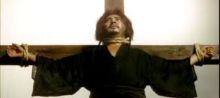
Japan, 1962. Down on his luck, low-ranking samurai Izo Okada (Shintarô Katsu) falls under the influence of aspiring politician Hampeita Takechi (Tatsuya Nakadai). As leader of an ultra-nationalist faction of the Tosa clan, Takechi plots to strip power away from the ruling Tokugawa Shogunate and hand it back to the Emperor. To that end he hires Izo as part of the “Hitokiri” - the historical name bestowed on four super-skilled swordsmen who brutally assassinate a series of key political figures on his behalf.
Hideo Gosha never found the international acclaim bestowed upon Akira Kurosawa but remains one of Japan’s great masters of the chanbara or samurai film. In later years he switched focus onto yakuza films and a series of fascinating historical dramas exploring the position of women in Japanese society, but back in 1969 delivered back-to-back masterworks with the acclaimed Gyokin and Hitokiri. Co-produced by superstar Shintarô Katsu, as an ambitious change of pace from his Zatoichi movies, Hitokiri’s original Japanese title was actually Tenchu! (exclamation mark included), which is what the assassins cry before despatching a target and translates as “Heaven’s punishment.” Takashi Miike fans may be aware the real-life historical figure of Izo Okada was the subject of the maverick director’s outrageous time-travel fantasy Izo (2004). With Hitokiri, Gosha took an approach that was almost as unorthodox, switching from political drama to knockabout farce and moments of stark, gore-drenched violence worthy of a gothic horror movie while exploring one of the most turbulent periods in Japanese history.
In a bold move, Gosha sidelines the manipulative Takechi and his moral opposite, Izo’s best friend and acting conscience, liberal leaning samurai Ryoma Sakamoto (Yujiro Ishihara), who in more conventional historical epics might have served as the focal point characters, and instead views events through the eyes of a slightly dim-witted brute who kills without question until he belatedly realises his benefactor is not the visionary idealist he appears to be. In doing so, one imagines Gosha was addressing the spirit of his own times given the Sixties saw right-wing politicians in Japan ally themselves with yakuza thugs in order to discredit the left-wing student movement. Katsu’s characteristically humanising performance turns Izo into a tragicomic boob whose occasional flashes of decency (refusing to murder Sakamoto, donating his profits to free his prostitute girlfriend from sexual servitude) counterbalance his homicidal nature and almost childlike naivete. Izo foolishly comes to believe the more people he kills, the further he will rise till an official rank and the princess he adores (who despises him as a “beast”) are within his grasp. He later grows sick of being treated like a dog and quits Takechi’s organization only to discover no other clan will hire him. He is trapped. Izo crawls back on his knees as his prostitute girlfriend (Mitsuko Baisho) cleverly observes she and he are basically the same.
Some western reviewers criticised Gosha for failing to adequately outline the complex historical conflict and concentrating on visceral action. There is some truth in this, though it is worth keeping in mind this was primarily aimed at Japanese filmgoers well versed in the Tokugawa period who could follow the plot without having to have the precise historical details spelled out. While the violence is lingering, bloody, suspenseful and truly unsettling, with the dreamlike photography of Fujio Morita imparting a near-psychedelic intensity, this is nevertheless a character-driven film whose stately pace and frequent time-outs to explore relationships may put off those expecting an action-fest. Scripted by Shinobu Hashimoto, co-screenwriter of classics like Rashomon (1950), Seven Samurai (1954) and Harakiri (1962) though sadly also known as director of Lake of Illusions (1982) (widely considered the worst Japanese film of all time), this is a intelligent, compelling, politically-charged allegorical epic. Katsu and Gosha assembled an all-star cast including venerated thespian and Kurosawa veteran Tatsuya Nakadai, former youth idol Yujiro Ishihara (Japan’s answer to Elvis Presley and Frank Sinatra rolled into one) and - in a casting coup - controversial novelist, homosexual advocate and, let’s face it, right-wing nut-job Yukio Mishima, subject of Paul Schrader’s biopic Mishima: A Life in Four Chapters (1985). He plays the one assassin almost as fearsome as Izo, who comes to a sticky end in a manner that eerily prefigures his real-life ritual suicide.
Bizarrely, Greek filmmaker Thanos Karmitsis remade Hitokiri as a low-budget, shot-on-video fantasy actioner in 2008 with the Japanese historical characters played by an all-Greek cast. This version spawned a sequel in 2010.