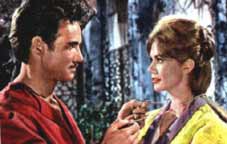
On the streets of Baghdad in days of old, wily thief Karim (Steve Reeves) steals from the rich to help the poor. His latest escapade involves impersonating Prince Osman, a suitor for the hand of Princess Amina (Giorgia Moll), so he can rob the guests assembled at the palace of the absent minded Sultan (Antonio Battistella). Karim and Amina fall in love at first sight. When the real, rather nasty Osman (Arturo Dominici) arrives on the scene, Amina is less than impressed. Evil vizier Gamal (Daniele Vargas) conspires with Osman to pass a love potion onto the princess but because she alreadly loves another, the drug poisons her instead. With Amina deathly ill, a mysterious spirit (Georges Chamarat) appears and advises the one thing that can cure her is the mystical blue rose. So Karim, Osman and a handful of other would-be suitors set off to find the elusive flower.
American muscleman Steve Reeves, widely considered the greatest bodybuilder of all time, shot to stardom in Hercules (1958) and thereafter became a fixture of similar Italian made peplum or sword and sandal films. Reeves flexed his pecs through drive-in favourites from Goliath and the Barbarians (1959) to the likes of The Last Days of Pompeii (1960), written and co-directed by Sergio Leone, before bowing out with his one spaghetti western, A Long Ride from Hell (1968) (a pet project he also scripted), to raise horses on his ranch till his eventual death in 2000 at age seventy-four. Co-produced by MGM and with Hollywood veteran Arthur Lubin at the helm, The Thief of Baghdad marks the third outing for this oft-told tale. Its plot runs closer to the 1924 Douglas Fairbanks silent classic rather than the beloved Alexander Korda production made in 1940 and was recycled once again for the underrated 1978 version pairing Roddy McDowall with Bollywood star Kabir Bedi.
Sporting sumptuous visuals from celebrated cinematographer Tonino Delli Colli, who went on to work with all the greats in Italian cinema from Sergio Leone and Federico Fellini to Pier Paolo Pasolini and Roberto Benigni, the film ranks among Reeves’ most lavish vehicles and showcases a more light-hearted and comical side to his, admittedly limited, reportoire. Reeves’ acting is not up to much, but he had an undeniably charismatic presence and proves a likeable hero. Instead of mere brawn, Karim survives by his wits and repeatedly displays his decency, notably by sharing water with his rivals after Osman destroys their provisions. The ensuing adventure pits him against a forest of eerie living trees that walk around on their roots (a striking mixture of puppetry and stop-motion effects), a sultry temptress (Edy Vessel) who turns men into stone, and a gaggle of what look like the egg men John Lennon sang of in “I Am the Walrus.”
Some of the slapstick humour comes across rather laboured but the film offers excitement and spectacle that compares favorably with vintage Hollywood efforts, including a well staged climactic battle and a charming sequence involving a flying horse, plus a likeable score from Carlo Rustichelli.