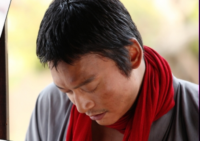
Blind swordsman Zatoichi (Shingo Hatori) renounces swordplay for the love of a good woman (Satomi Ishihara). Barely five minutes after he does so, his wife is accidentally slain by a young samurai named Toraji, who was aiming for Ichi. A despairing Ichi returns to his childhood home, a village by the sea where he is sheltered by a friend named Ryuji and his disapproving mother. He also meets Toyo (Youki Kudoh), an old flame now married to benevolent yakuza boss Tatsuji. A new breed of yakuza thugs, led by the swaggering Tendo, begin terrorising local farmers and fishermen. It’s all part of a (frankly obscure) plan for total domination by a senile but brutal feudal lord whose son is none other than guilt-ridden Toraji. After some friends are murdered and Toyo is raped, Ichi sets out to defend the downtrodden, but betrayal and bad luck seal his doom.
Seven years after “Beat” Takeshi Kitano’s quirky and humorous remake, Toho delivered yet another new take on the sightless swordsman, starring former boy band heartthrob Shingo Hatori in the role made famous by Shintarô Katsu. Seemingly influenced by recent humanist samurai dramas like The Twilight Samurai (2002), director Junji Sakamoto downplays the action and puts the emphasis back on character interaction, qualities that were always part of the Zatoichi series, only the tone is excessively somber and sorrowful, taking the trend for demystifying heroes a step too far. Missing in action are those moments of slapstick and tragicomic pathos celebrating the enduring qualities of the human spirit. In their place we have arguably the bleakest Zatoichi film since Zatoichi in Desperation (1973), only nowhere near as accomplished, with a cynical, fatalistic view of human nature as Ichi is betrayed by friends, crippled with angst, and finds his heroic efforts fall short.
Shingo Hatori gives a capable performance as arguably the first Ichi who seems like a real blind person struggling in feudal Japan rather than a superhero. But this new take on the classic character lacks authority and his strangely slapdash swordplay would make more sense were this a prequel and not, as the title implies, an attempt to draw a definitive end to the series. Zatoichi: The Last hits all the familiar notes: Ichi wins big at the local gambling den, defends the downtrodden, squares off against the usual super-skilled opponent. Yet the formula never catches fire, which has less to do with the change in leading man than the directionless and often confusing plot. There is a lack of urgency that further dilutes the drama which is already somewhat maudlin and heavy handed.
Revered actor Tatsuya Nakadai, star of Harikiri (1962) and Ran (1985), essays the lead villain although his plotline confusingly never intersects with Zatoichi until the very end. Samurai film veterans Chieko Baisho and Yoshio Harada also appear in significant roles. The film is very handsomely photographed by Norimichi Kasamatsu whilst the excellent ambient electronica soundtrack enhances its Zen Buddhist atmosphere. Nevertheless, the relentlessly grim and rather awkwardly staged finale provides a sorry send-off for such an iconic character. Fans would be better off with the Kitano film or, better yet, Katsu’s own swansong, Zatoichi the Blind Swordsman (1989).