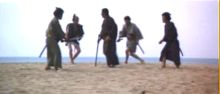
While crossing a rickety old bridge, a shamisen-strumming old lady runs into blind swordsman Zatoichi (Shintarô Katsu) and warns him to watch out for holes. Out of gratitude, Ichi hands the old woman a gold coin. She reaches for it, then promptly plummets down a hole to her shrieking death! A guilt-ridden Ichi seeks out the dead woman’s daughter, Nishikigi (Kiwako Taichi), whom he discovers works as a prostitute near the fishing village of Chosa, whose inhabitants are terrorized by violent yakuza led by ruthless Boss Mangoro (Asao Koike). Nishikigi is so world-weary she simply shrugs off her mother’s death, but Ichi is determined to atone for his deeds. He buys her freedom from the mob, proposing they settle down and build a life together. This upsets Nishikigi’s boyfriend, Ushimatsu (Katsuo Nakamura), who had been saving his money to do the same. They continue their affair under the blind man’s nose, until Ushimatsu hatches a plan to collect the bounty on Zatoichi’s head...
Having produced his Zatoichi films for several years, along with other innovative movies, and debuted as a writer-director with the crime thriller Kaoyaku (1971), it was inevitable that star Shintarô Katsu would finally script and direct an entry in the popular chanbara series. Some sourcebooks claim Zatoichi: Oreta Tsue (Zatoichi: Broken Stick, released on DVD as Zatoichi in Desperation) was the climactic entry in the original series, whilst others maintain that honour belongs to Zatoichi: Blood Festival in Kasama a.k.a. Zatoichi’s Conspiracy. Either way, this was Katsu’s magnum opus and ranks among the most artful and ambitious of all Zatoichi films.
Right from the start, as the credits run over a blank screen in total silence, the film strikes an eerie ambience different from any other entry. Katsu evidently had something to say with this story. He pitches the tone stylistically midway between gritty art movie and gothic horror with Buddhist overtones, much like all great Asian horror films from Jigoku (1960) to Ringu (1998). Gone are the instances of crowd-pleasing comedy along with all hints of tragicomic pathos. In their place Katsu delivers a Zatoichi truly haunted by guilt, as embodied in a frenzied montage of abstract images showing the old woman tumbling to her death. His quest for redemption leads him into a nightmarish landscape that, if not hell on earth, is akin to purgatory populated by doomed souls, vulture-like yakuza and morally ambiguous bystanders.
Throughout the first act, Katsu keeps his camera at street level and conjures a grimy, earthy atmosphere as he simply observes daily life in the brothel. “These geishas are yours, gentlemen. You can bite them or lick them. They’re all yours”, a ghoulishly obsequious old madam tells a gang of surly street punks. Much like Kenji Mizoguchi, Katsu uses the figure of the prostitute as emblematic of the plight of working class Japanese. As Nishikigi sees it, all Ichi’s has done is rob her of a way to earn a living. The scene where she punctures his chivalrous impulses and deflates his dream of domestic bliss, is quietly devastating. By her reckoning, anyone who exhibits a conscience is simply selfish, because they want to save their soul rather than simply go with the flow and make brutal reality more bearable. There is no room for Ichi’s code of honour in such an amoral world. He has become a man out of time, in more ways than one.
Katsu hits all the familiar series tropes but subverts them in unexpected and often unsettling ways. Most notably in the subplot concerning fourteen year old Kaede (Kyoko Yoshizawa) and her kid brother Shinkichi (Yasuhiro Koume). Any other Zatoichi movie would cast these two as sidekicks. Here, their paths never intersect. Ichi is too preoccupied with fruitlessly courting Nishikigi to notice the two characters who most need his help. Katsu draws powerful powerful performances from the young actors and the scene where they contemplate throwing themselves into the sea illustrates the film’s overall atmosphere of subdued horror. The plot piles on the indignities till Ichi is driven to act: the yakuza abuse a mentally ill young man who thinks he is a woman. They bully local fishermen and burn their boats. A lone brave child musters a futile act of defiance, throwing rocks at Boss Mangoro, but is bludgeoned to death after which the yakuza slaughter all witnesses. In a plot twist that recalls Katsu’s infamous sexploitation samurai film Hanzo the Razor (1972), Ushimatsu convinces Nishigiki to have sex with Zatoichi, because it is the only time he would be vulnerable to an attack. This proves a surprisingly suspenseful scene with spurting blood replacing the expected orgasm.
Stealing an idea from Django (1966), the villains smash Ichi’s hands to a bloody pulp, thus making future swordplay impossible. Or so they think. The finale, an orgy of blood that is simultaneously nightmarish and cathartic, is fittingly the most audacious and powerful in the entire Zatoichi series, concluding with the roaring ocean waves that has been a reoccurring motif throughout the series. Of course, this was not quite the end for the sightless swordsman. Katsu revived the character for a long-running television series and again for one last hurrah with Zatoichi the Blind Swordsman (1989). Following Katsu’s death in 1997, Beat Takeshi made the role his own in the idiosyncratic Zatoichi (2003), Haruka Ayase played a female version of the iconic character in Ichi (2008), and most recently former boy band idol Shingo Katori took the lead in Zatoichi: The Last (2010).