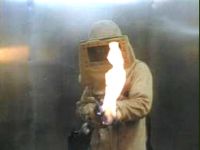
Donny Kohler (Dan Grimaldi) works at the city incinerator, getting rid of the garbage there, but today he suffers a trauma when one of his co-workers is trying to fetch an aerosol can from one of the furnaces and it explodes, setting him on fire. Donny simply stands there aghast, unable to move, so when two other workers rush up to put out the flames he gets a real telling off from those who cannot understand why he didn't act to do something about the accident. Donny has one friend, Bobby (Robert Osth), who sticks up for him, but today is going to be one of those days...
This obscure variant on Alfred Hitchcock's Psycho might have been forgotten about entirely if it was not for two reasons, one following on from the other. First, Donny turns killer and uses a very particular way of executing his victims, and second it was that modus operandi which caused the film to briefly end up on the notorious British "Video Nasties" list, which detailed a bunch of largely grotty horror movies which would have been prosecuted if they had been shown or released uncut in that country. Of course, censorship has relaxed sufficiently that almost all of those films are perfectly legal for Brits to watch these days fully intact.
Nevertheless, these efforts did have a certain cachet among horror fans for being the bad boys of their genre, even though if you actually sat down to watch something like Don't Go in the House your impression of it might not be entirely favourable. Sure, there was one scene here which was unbeatably horrible for its day, but that was one two minute sequence out of an eighty minute work, and the rest tended to coast on how far the filmmakers had gone with that sequence, something they did not repeat for the rest of the running time. In the remaining course of the plot, you were stuck with watching the mentally unbalanced Donny moping about and trying to block out the voices in his head.
One of which belongs to his mother, who he came back from work that terrible day to discover has died, which tips him over the edge, although we see in intermittent flashbacks the grounding for that was when she used to torture him as a young boy by burning his arms over the stove (unconvincing, superficial psychology alert!). Therefore when Donny thinks he's finally free, he does what any mother-dominated sufferer would do: he puts on a disco record, jumps up and down on an armchair, and smokes a ciggie. Wait, that's not very scary, so director Joseph Ellison and his co-writers (one of whom was a woman, Ellen Hammill, perhaps to stave off accusations of misogyny) make Donny into a serial killer.
Some have noted the similarity to another, better known nasty in Maniac, which came out the same year as this but was actually filmed later, but it appears it was that psychology which the writers were keen to explore, so allot far too much time on their main character fumbling through his day to day life and getting increasingly distracted by his psychopathic urges. These are made plain when he manages to invite a woman back to the house of the title, the one you're not supposed to go into although one look at Donny could have told any sensible person that, then he knocks her out, strips her, chains her up and sets a flamethrower on her, which is more brutal in concept than visually as the special effects were not up to much (this was a low, low budget enterprise). But it is undeniably brutal, and that part has turned more than one viewer off completely - though not our old friend Quentin Tarantino, who championed the movie personally. Everything after that moves in morose fashion to a predictable conclusion, as if Ellison was admonishing us, you're not meant to be enjoying yourselves, you know! Music by Richard Einhorn.




 Display comments