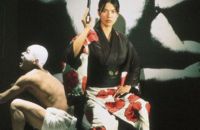
Stray Cat (Makiko Esumi) is a sexy, kimono-clad professional killer currently ranked number three in a surreal world where everyone is either an eccentric assassin or else a target. Her goal is to become number one. Stray Cat gets her chance when Miss Uekyo (Sayoko Yamaguchi), masked boss of the Assassin’s Guild, with whom she shares implied lesbian relations, announces the number one killer known as Hundred Eyes is now a target. In a mad scramble to uncover her opponent’s identity and shoot her way to the top, Stray Cat battles an array of wacky would-be contenders including a wheelchair-bound rival, a cowboy costumed westerner who is impervious to pain, and the bleach-blonde, enigmatic Man in Black (Masatoshi Nagase) who actually claims to be Hundred Eyes. Wherever she goes Stray Cat is followed by a colourfully-clad, lantern-bearing little waif named Sayoko (Hanae Kan). Initially hostile, Stray Cat warms to the child after she saves her life and asks to become her apprentice. Strange surprises await before Stray Cat’s quest climaxes in an existential shootout in the netherworld and a confrontation with her crippled mentor the Champ (Mikijiro Hara).
It took thirty-four years before mad genius Seijun Suzuki concocted this delightfully deranged sequel to his landmark avant-garde hit-man flick, Branded to Kill (1967). The original film proved the proverbial straw that broke the camel’s back. Its supposedly “incomprehensible” nature got Suzuki sacked from Nikkatsu studios, after a career spent habitually ripping up every page in the cinematic rulebook. Fast-forward three decades and Suzuki bounced back to critical acclaim with a string of award-winning art-house masterpieces and even entered the public eye as the star of a popular soap opera. Which is when producer Satoru Ogura offered Suzuki the chance to revisit the scene of the crime. To Japan’s foremost cinematic anarchist, the irony alone must have seemed divinely delicious and surely irresistible.
Just like the original, the sequel transports us to a place we rarely glimpse outside the world of dreams. But whereas Branded to Kill was an irreverent nightmare in film noir black and white with its roots in a savage script co-written by Atsushi Yamatoya - later director of the even more unsettling Inflatable Sex Doll of the Wastelands (1967) - Pistol Opera explodes in a riot of pop art whimsy courtesy of long-time anime and Gamera movie scribe, Kazunori Ito. We freefall into an abstract realm drawn from Suzuki’s own dream journals as the master director combines opera, traditional Japanese kabuki and noh theatre, butoh dancing with Hollywood musicals, ghost stories with imagery culled from his old Nikkatsu action flicks.
Many films have been described as dreamlike, but Pistol Opera is among the few that genuinely captures the experience of watching a dream unfold. Characters behave in an oddly detached or eccentric way, whilst Suzuki’s staccato editing and offbeat staging set the world off-kilter in subtly unsettling ways. Some have likened his work to that of David Lynch, particularly Eraserhead (1977), but his vision is far less oppressive and disturbing. Set to a bouncy free-form jazz-meets-reggae score, Pistol Opera spins a story that is more playful and engaging than Lynch’s walk on the weird side. Equally, while Branded to Kill was an anti-masculine satire driven by frustration and impotence, Pistol Opera runs on a feminine sexual energy whether it’s the quasi-lesbian relationships that unfold between the three principal characters, or Stray Cat’s obsessive urge to masturbate in a room inexplicably full of bright red flowers. At one point, in a sapphic subversion of the near-paedophilic relationship in Léon (1995), young Sayako offers sexual favours which Stray Cat refuses, preferring self-satisfaction. “Dogs follow masters, but I am a Stray Cat”, she taunts the lavender veiled Uekyo later on, an allusion perhaps to the rebellious Suzuki. Charismatic lead Makiko Esumi delivers a genuinely cat-like performance, slinky and playful as she disappears and reappears in different places like some kind of Tex Avery cartoon character. Her cocksure, controlled demeanour is sharply contrasted with the embittered Champ, whom the film hints is actually Goro Hanada, the surviving hit-man hero from Branded to Kill although producer Ogura inexplicably vetoed Suzuki’s desire to recast the iconic Jo Shishido in his signature role.
The set design is simultaneously sparse yet evocative and very chic from the colourful kimonos worn by the lead actresses to the delirious set-pieces conceived by Suzuki alongside his long-time production designer, the incredibly talented Takeo Kumra, and special effects supervisor Shinji Higuchi, who handled monster effects for the Gamera films. Beneath the lunacy however, lies a compelling meditation on death and how one cannot go through life without being emotionally vulnerable. It culminates in a finale that is like some made stylistic fusion of Hieronymous Bosch, Jean Cocteau, classic Japanese horror film Jigoku (1960) and, believe it or not, The Man with the Golden Gun (1975), as Stray Cat faces her nemesis amidst a carnivalesque inferno full of growling ghouls. Yet whereas Goro Hanada went loudly bonkers when he ran the gauntlet, Stray Cat stays serene, even triumphant in madness. Much like Suzuki himself, maybe.
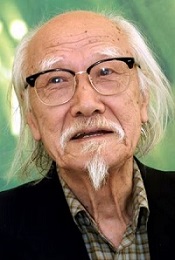
A true rebel in the system, Seijun Suzuki marked out his distinctive style by taking a pop art approach to the gangster cliches he was ordered to make for the Nikkatsu studio, such as Youth of the Beast, Gate of Flesh, Tokyo Drifter and Branded to Kill, but he eventually fell out with them over his wild visuals and spent a decade in the wilderness of television and the independents before he was rediscovered in the late seventies. He was making films into his eighties, with Pistol Opera and Princess Racoon winning acclaim in the 21st century.