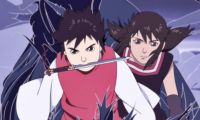
In Heian-era Japan, a war rages between humans and demons. Samurai warriors bravely defend citizens in the city later known as Kyoto from hairy, rampaging Oni (“demons”) and their army of giant monsters. Wise, all-knowing monk Gen’un (voiced by Shidou Nakamura) foretells the arrival of a “saviour” who will turn the tide against the Oni menace. That saviour turns out to be someone from the 21st century: Jun Tendo (Kensho Ono), an average schoolboy coping with the loss of his father. His dad died saving a child from a train crash. Now Jun worries whether he can summon the same courage. Outside his father’s funeral, Jun is suddenly attacked by a small Oni and seeks refuge at a local museum where he meets none other than Gen’un. The mystic monk sends Jun into the past. Throwing his lot in with the samurai, Jun befriends Raiko, a young, super-skilled yet strangely troubled warrior based on the real historical hero: Minamoto no Raiko. Jun also discovers he alone has the power to summon Yamata no Orochi, the legendary eight-headed, eight-tailed dragon whose might proves handy when monsters attack.
Just like Hayao Miyazaki’s celebrated Princess Mononoke (1997), this lavish historical fantasy anime is set at a crucial point in the development of Japanese civilization and shares some common themes, namely the tension between mankind’s urge for progress and the need to live in harmony with nature, and a lone hero caught between two warring cultures. Its most intriguing twist occurs in the aftermath of the monster attack, as Jun discovers an injured Oni is actually a young girl named Mizuha (Satomi Ishihara). Orochi the dragon spirits both youngsters back to the Oni village where Jun discovers the demons are actually human members of the imperilled Magatama clan. They use magic masks to transform themselves into mythological monsters. The screenplay, co-written by director Hirotsugu Kawasaki, best known to anime fans for his cult sci-fi actioner Spriggan (1998), posits a radical reinterpretation of the term “oni”, moving away from demons and ghosts to represent those tribes and cultures the Kyoto noblemen intend to wipe out of history.
By comparison with the masterful Miyazaki anime, Legend of the Millennium Dragon simply pays lip service to these compelling concepts, they’re simply gimmicks. Kawasaki delivers an altogether more conventional, even one-dimensional adventure yarn. Flashbacks struggle to tie Jun’s personal problems in with his present dilemma, while we never really learn what marks him out as “the saviour.” He displays no special qualities. Gen’un is a similarly unfathomable opponent who goes from sagely mentor to ranting supervillain at the drop of a hat. Later on, Kawasaki abruptly introduces four more heroes from Japanese legend whom we barely get to know before they are thrust into the heart of the story: the so-called “Four Guardian Kings” Watanabe no Tsuna, Kintaro (who starred in his own anime epics Taro the Dragon Boy (1979) and Taro Maegami (1979) besides cameoing in several other anime), Urabe no Suetake, and Usui Sadamitsu. Viewers unfamiliar with Japanese history and mythology will be none the wiser.
Orochi the dragon, at first noticeably lacking its other seven heads and tails though it sports an extra pair of eyes, is similarly drawn from ancient myth, specifically the legend of the demigod Susano which was adapted into the classic anime: Little Prince and the Eight-Headed Dragon (1963), co-directed by future Studio Ghibli co-founder Isao Takahata. The dragon first graced the screen in Toho’s lavish live action mythological epic The Three Treasures (1959) starring Toshirô Mifune, later remade as the effects-fest Yamato Takeru (1994). It also inspired the creation of Ghidorah: The Three-Headed Monster (1964), one of Godzilla’s most enduring foes.
As a straight-up monster fest, Legend of the Millennium Dragon most definitely delivers. Besides the cloud-surfing Orochi we have a gigantic stone ogre, icky giant spiders, tengu bird goblins, fiery elemental beings and glowing demon gods. The fantasy battles are a triumph of eye-popping pyrotechnic verve with the scratchy designs of the skull-masked, simian-like Oni quite distinct from the other computer coloured characters, in a manner that oddly recalls the rotoscoped Orcs from Ralph Bakshi’s The Lord of the Rings (1978), albeit considerably more accomplished. While the animation is often stunning throughout several sequences in the Heian era, early scenes set in contemporary Japan are jarringly crude with Tatsuya Tomaru’s odd chara designs more suited to cheap Saturday morning kid’s cartoons. The characters are earnest but lack charm and quite how Jun makes it back to the 21st century is never explained. Theme song co-written by JC Chasez, formerly of boy band ’N Sync.