New York City: a young woman falls from the top of a skyscraper. Her body shatters like glass. She becomes the first confirmed victim of the Medusa Virus, a sickness that turns victims to stone, that spreads worldwide with terrifying rapidity. As billions die and civilisation lies on the brink of extinction, the Venus Gate corporation launch their so-called “cold sleep” project as a last ditch attempt to secure a future for humanity. One hundred and sixty people from around the world are chosen by lottery to be cryogenically frozen for one-hundred years, in the hope that the virus might be cured or simply die out. However, the US government suspect the hitherto scandal-ridden Venus Gate orchestrated an act of bio-terrorism and smuggle a sleeper agent into the cryogenics project.
Among those chosen is Kasumi Ishiki (voiced by Kana Hanazawa), a shy, introverted Japanese schoolgirl, devastated at being torn away from her twin sister Shizuku (Eri Sendai). Kasumi and her fellow cryo-sleep subjects assemble at a hi-tech facility inside a fairytale castle in the remote Scottish highlands. Here a state-of-the-art super-computer dubbed ALICE, voiced to sound like a friendly little girl (Misaki Kuno), safeguards their slumber for the next one hundred years. However, Kasumi awakens to find the facility overrun with thorny vines. And hideous flying monsters that rip the survivors to shreds! Panic ensues as other awakened patients fall down an elevator shaft into the gaping mouth of a huge tentacled horror or are hunted by other monsters.
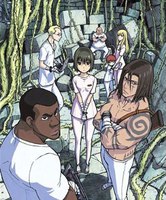
Only Kasumi escapes through to the next level along with six more survivors: tattooed tough ex-con Marco Owens (Toshiyuki Morikawa), blonde nurse Katherine Turner (Sayaka Ohara), black cop Ron Portman (Kenji Nomura), self-serving Italian senator Alexandro Pecchino (Kousei Hirota), tech guy Peter Stevens (Shinichiro Miki) and Timothy (Akiko Yajima), a six year old boy obsessed with video games who immediately spots strange parallels between real events and his favourite game. Even though none are exactly who they seem, faced with more monster attacks and mounting paranoia, the seven strangers band together in an attempt to reach an outside world that may not even exist anymore.
Eagerly awaited by fans, this lavish anime adaptation of Yuji Iwara’s hit manga does not disappoint. Comparisons have been made with Aliens (1986) - what with the claustrophobic, dilapidated industrial setting overrun with H.R. Geiger-styled monstrosities - and the landmark television series Lost with its air of ambiguous mystery and tricksy, flashback-riddled narrative shading characters’ back-stories that eventually intertwine. However, the Scottish setting and fairytale motifs (notably Sleeping Beauty, which of course concerns a heroine who falls asleep for a hundred years in a castle engulfed by thorns) are distinctive and the film balances techno-whimsy with humour and graphic horror in that uniquely Japanese way. Where else could you see an S.A.S. commando getting his ass kicked by a girl in an elegant cocktail dress?
Unlike many post-apocalypse dramas, King of Thorn does not rush through the stage-setting preamble to get to the immediate nightmare but spends time methodically detailing the spread of the virus and the characters’ preparation for cryo-sleep, exploring their personal dramas. Some fans have complained about the liberties taken with Iwara’s manga. A few notable characters have been omitted and some back-stories have been drastically condensed to highlight the crucial Kasumi/Shizuku relationship. However, Kazuyoshi Katayama, director of the intriguingly offbeat The Big O (1999), does a fair job streamlining the more mind-melting aspects of Iwara’s labyrinthine narrative - whose density rivals that of Inception (2010) - and layers the plot with metaphysical musings on life, death, the nature of reality and the existence of God. He pulls off some compelling twists and turns and his stylish direction yields set-pieces of nail-biting suspense. Fluid animation fuses traditional hand-drawn characters and backgrounds with eerie CGI monsters to striking effect, climaxing as the castle itself metamorphs into the titular King of Thorn, a spectacular creature reminiscent of the opponent in Godzilla vs. Biollante (1989). What truly impresses though is the film’s ability to fuse ingenious science fiction ideas with solid human drama as characters display qualities they never knew they had while the plot charts Kasumi’s journey from sulky self-doubt to one heck of a shock self-revelation.