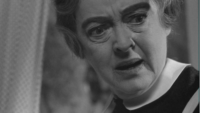
Today little Joey Fane (William Dix) is returning home after two years away, but his mother Virgie (Wendy Craig) has mixed feelings about this, and is in fact facing the prospect of going to pick him up with near-hysterical tears, even though her husband Bill (James Villiers) insists she pulls herself together. Joey was a problem child, you see, refusing to eat or sleep and taking a serious dislike to the family nanny (Bette Davis), in spite of her basically looking after him and his little sister (Angharad Aubrey) when their mother was incapable. But the sister isn't around any more, is she?
And there's a reason for that, which the plot hinges on but in Jimmy Sangster's script for Hammer's final black and white film it is not revealed until the halfway mark. We are aware that the little girl is no longer part of the Fane family, and that's not because she has been sent away, it's because she's dead, and Joey had been sent to a children's mental home as it is thought he was responsible, that much you can work out. However, Sangster and director Seth Holt preferred to keep the audience guessing, which was rather more difficult than they might have anticipated when they cast Davis as the Nanny: after Whatever Happened to Baby Jane? revitalised her career, little wonder.
Would anyone really accept her as anything other than a dangerous presence in a thriller, never mind a psychological horror as The Nanny turned into? If that casting somewhat scuppered the suspense of the first half, then it did allow the film to work up an atmosphere akin to that of the source of evil child movies as we know them, The Bad Seed, as Joey acts pretty terribly towards all and sundry, which you're meant to see as evidence of his maladjusted development. He is consistently rude and unhelpful, refusing to do anything his parents say if it means he spends any more time than he needs to with Nanny: as our introduction to him sees him faking a suicide by hanging he does appear resistable.
This wouldn't be half as good as it was if the acting wasn't up to snuff, but every performance here, including the tricky roles of the children, was achieved with exemplary professionalism. One of the great British child actors was Pamela Franklin and she's in this too as the upstairs neighbour Joey strikes up an unusual friendship with; she's happy to listen to his stories of what he thinks is really going on with his guardian as long as he can steal her cigarettes from his father's supply, and gradually begins to come around to his way of thinking. Theirs is a well-observed and believable relationship, just quirky enough to fit right into the uneasy goings-on in the Fane household, which intensify as the drama proceeds.
That's down to Joey accusing Nanny of killing his sister then pinning the blame on him, and as she's the figure of authority everyone accepts her side of it and he gets punished. Poor Joey doesn't react to this very well, and it's interesting to see him portrayed as an unfriendly and even obnoxious personality, which muddies the waters about who was truly responsible for his sister's demise. Naturally all that goes out of the window once Nanny starts acting suspiciously in our eyes as well as his, something which does not escape the notice of Virgie's sister Pen (Jill Bennett), who, oh dear, has a heart condition. If you can largely guess the way this will turn out, it doesn't make the journey any the less absorbing, and it's easy to highlight Davis as the cause of this being as well handled as it is as she cleverly doesn't lapse into camp which she easily could have. Only the introduction of an abortion subplot late on is a little out of place, otherwise The Nanny was very satisfying. Music by Richard Rodney Bennett.