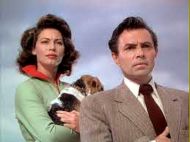
Today a crew of fishermen from this Spanish port in the Mediterranean have made a grisly discovery: two of the tourists who disappeared in last night's sudden storm have been caught in their net, quite dead. As the locals gather on the shore to see what's happened, the couple's friends and acquaintances also appear, and for racing driver Stephen Cameron (Nigel Patrick) he knows he has lost far too much. Another friend is Geoffrey Fielding (Harold Warrender), and it is he who relates the story to us, the story of a most unusual love affair...
Filmmaker Albert Lewin was a most unusual chap himself, with his literary pretensions and, once branching out on his own, the sense that great cinema should be of the same calibre as a great novel. His most famous work was an adaptation of Oscar Wilde's The Picture of Dorian Gray, but a cult following developed for this, his updating of the legend of the Flying Dutchman to the nineteen-thirties, taking as its premise the idea that the figure of seafaring myth had actually survived to the twentieth century, forbidden to die for blaspheming and cursed to roam the oceans forever more.
Well, that is until he finds a woman willing to die for him, which has proved tricky judging by the fact he's been around for three hundred years with no luck, but who's that we see looking glamorously out to sea? Why, it's Ava Gardner playing Pandora, not the one from Greek legend, but as with much of this happily alluding to that kind of classical education Lewin so treasured. Another indicator of that was the mention of famous Persian polymath Omar Khayyám, specifically his poem about the Moving Finger which is quoted from; Lewin loved this man's work and was keen to reference it at every opportunity, so he must have been kicking himself he never got to make the biopic of the much respected scholar.
But bear all that in mind and you have some idea of the straining for high falutin' quality that was on display here, as if the writer and director was thinking, "This shall be my masterpiece!" For some viewers it was, but for many others at the time it was judged to be stultifyingly pompous in its aspirations, not that this prevented its success at the box office thanks to rising star Gardner, here in her first colour film which showed off her complexion due to Jack Cardiff's rich (a little too rich, frankly) cinematography. Since the film's orginal derision, there are a loyal band who have rediscovered it down the years and its strange, almost dreamlike parade of fantasy and jaded reality.
Certainly Pandora is jaded, offering to marry the infatuated Stephen out of sheer boredom rather than because she loves him, and the atmosphere of eroticism borne out of being so through with life's simple pleasures was evidently being aimed at here, which leads Pandora on to something resembling a death wish when she swims naked to the boat of the Dutchman, which by now has transformed itself into a modern yacht. James Mason played that man, Hendrik van der Zee, now a painter and just as fed up with his admittedly more supernatural lot as Pandora is, so that they are a perfect match. At first you think the whole myth angle is metaphorical, that is until Hendrick survives murder courtesy of a bullfighter (!) who has also fallen for Pandora's charms, and you realise yes, this is magic realism of a sort here. If you could buy into its sickly romanticism and overreaching ambitions this wasn't quite like anything else, but be warned it moved like treacle to its foregone conclusion. Music by Alan Rawsthorne.