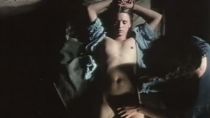
Alice (Rena Niehaus), a pretty girl from a wealthy family, is kidnapped on her way home from school. She is imprisoned in an isolated country house and kept tied to the bed. Gang leader Gino negotiates the ransom while family man Paolo (Flavio Bucci, who played one of the thugs in Aldo Lado’s infamous Night Train Murders (1975)) visits his sick child at home. It falls to Michele (Michele Placido), a poor young immigrant from Calabria in Northern Italy, to keep an eye on Alice. However, he can’t resist stripping the unconscious girl so he can fondle her breasts and private parts, eventually performing oral sex to her evident satisfaction. Before long, the self-assured Alice uses her feminine wiles on the naive country boy, trying to persuade Michele to ditch his partners, seize the ransom money and run away with her.
Former Playboy Playmate Rena Niehaus is clearly not the same age as her schoolgirl character, which only slightly softens the unsavoury paedophilic aspect to this sleazy Italian drama that can’t quite decide between sexploitation or mounting a sincere attempt at drawing attention to a serious social issue. Known as The Snatch in some quarters, La Orca, whose title translates as “The Whale” (an obscure reference to the designer outfit worn by our anti-heroine, though some sources claim “The Ogress” as more accurate, alluding to her supposedly “monstrous” nature), has a plot that harks back to No Orchids for Miss Blandish, the scandalous James Hadley Chase story filmed in Britain under the same name in 1948 (denounced by the Monthly Film Bulletin as: “the most sickening exhibition of brutality, perversion, sex and sadism ever to be shown on a cinema screen”) and in Hollywood as the gruelling The Grissom Gang (1971). Another likely influence was the then-recent kidnapping of heiress Patty Hearst.
Of course kidnappings were rife in crime-ridden Seventies Italy where harsh austerity measures drove the poor to increasingly desperate acts, as later explored by Gabriele Salvatores in his altogether classier I’m Not Scared (2003). Eriprando Visconti, supposedly the nephew of celebrated movie maestro and Marxist polemicist Luchino Visconti, initially draws both victim and kidnappers in an equally sympathetic light. But his attitude to all the characters grows increasingly ambiguous, to the point where viewers are left uncertain who they are supposed to empathise with. Paolo’s situation with a sick child leaves him initially sympathetic, but a visit to his wife proves simply a throwaway excuse for another explicit sex scene. We then discover she isn’t his wife at all but married to some other man who is working abroad to support a child that presumably isn’t his. Michele goes from downtrodden fisherman (Italian viewers will note fair-skinned hunk Placido is less-than-convincing as a rough hewed Northerner, though his performance is generally fine) to statutory rapist while somehow remaining the focal character. Shortly after molesting Alice he denounces her as “a whore who’ll sleep with anyone.”
Where the film truly falters is in abruptly turning Alice from believable kidnap victim into some kind of mythological siren luring working class men to their doom. She seems unnaturally poised, cunning and worldly for schoolgirl in such a dangerous situation, although the film hints at a troubled family background by way of explanation. The key line belongs to Michele when he remarks his fellow kidnappers are not his brothers, which implies the film is intended as an allegory for the seduction of naive, impoverished young men by the coldly manipulative bourgeoisie. Funny how these Italian films always single out carefree young women as ideological hate figures, rather than the old men more often responsible for political corruption and dodgy business practices.
The fact is a right-on Marxist agenda is not enough to make the sexual abuse of young girls palatable viewing. Equally, the idea a privileged child is inherently equipped to psychologically manipulate working class criminals is rather absurd. Rena Niehaus actually gives a pretty decent performance, with the camera highlighting stern eyes that make Alice seem old before her time. She later graced Damned in Venice (1978), an Antichrist-themed horror film exhibiting an equally disdainful attitude towards young women as the root of all evil. The disco soundtrack by Federico Monti Arduini goes saxophone-heavy for the steamy sex scenes, betraying the film’s real source of interest. Remarkably, even though the ending is conclusive - and as some have is somewhat reminiscent of Last Tango in Paris (1972) - this spawned a sequel: Oedipus Orca (1977).