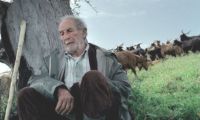
An old shepherd (Giuseppe Fuda) herds his goats in the hills of Calabria, at the southernmost tip of Italy. He is sick and approaching the end of his days. Still he believes his medicine lies in the dust he gathers off the floor of his local church, which he drinks in his water every day. One morning the sleepy village is thrown into disarray by a series of comically chaotic events that set in motion a most unusual odyssey.
Nary a word is spoken throughout Le Quattro Volte, save for the occasional muffled utterance, yet its storytelling is accessible and eloquent. More than simply “the silent goatherder movie”, some see this tranquil tragicomedy as nothing less than a cosmic contemplation of life, the universe and everything. That may sound like overreaching, and a few detractors felt its metaphysical aspirations sat ill beside the humble poetic realities of rural life, but honestly this film achieves its ambitions towards spiritual profundity. Le Quattro Volte is miraculous. Its title - which translates literally as the four “turns” or “phases” - refers to the world as described in the philosophy of the ancient Greek mathematician Pythagoras, in essence a theory of a cycle of eternal transformation and reincarnation. Put simply, the film is about things turning into other things. Writer-director Michelangelo Frammartino envisions cinema not as a means of observing reality in dry documentary fashion but exploring the invisible threads that bind man and nature, the interconnectedness of all living things. The landscape is a major character within the movie, which Frammartino turns at least in part into a hymn to the natural beauty of his native region of Calabria.
His remarkable direction makes the viewer one with the elements, in somehow simultaneously the most unassuming yet awe-inspiring manner possible. Those dust particles that float down from the church ceiling glitter like cosmic matter from the heart of the universe. At one point we are mesmerised watching an ant crawl across the old man’s face. Frammartino immediately shows us the flipside: a man in the distance scales a tall tree, looking all the world like a little ant. The film has no overtly religious overtones yet remains deeply spiritual and vast in scope, giving us a vision of something all too rare in cinema: the breadth of creation. Despite his ambitions, Frammartino does not seek to be solemn. At the heart of Le Quattro Volte lies an incredibly witty slapstick set-piece wherein an angry dog, a runaway truck and hordes of inherantly anarchic goats combine to wreak havoc in the village. The world briefly turns upside down. Animals inhabit the village, seizing their chance to see how the other half live.
After a significant event, the film shifts focus away from men towards goats, beginning with the birth of a little white kid. It becomes the goats’ story, their view of the infinite skies, the simple wonders of everyday life. As the little kid stumbles exploring the strange sensation of being alive, the goats’ personalities prove as vivid as those in a Disney cartoon, only minus any cloying anthropomorphic traits. Compelling enough in their, well, simple goat-ness. Once again the story shifts its focus after the little kid is lost from the herd and finds shelter beneath a vast, seemingly all-knowing tree. Frammartino makes this tree a cinematic monolith as awesome as the one in 2001: A Space Odyssey (1968), granting us a god’s eye view of all creation until we come crashing back down to earth, felled by the hand of man.
But this proves no callous desecration of nature. The tree is erected at the centre of a village celebration, a celebration of the cycle of life much like the film itself. As we continue to follow the cycle of permutations (tree into chopped wood, wood into smoke), we feel as if we have been on an epic, eye-opening journey without ever leaving the confines of this quiet, isolated little village. That is great cinema.




 9 (from 2 votes)
 Display comments