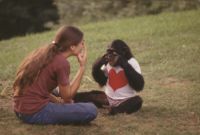
In Oklahoma during 1973, a baby chimpanzee was taken from its mother kept in a compound for the apes, with a view to experimenting upon it. But not through vivisection, as it was the psychology of the animal researcher Herb Terrace was interested in, to whit: could a chimp brought up as a human and taught to communicate essentially act like a person? To that end, the chimp was given to a New York family of Terrace's acquaintance and instructed in the ways of sign language, all as if he was one of the large number of children in the house. Was this a good idea?
You're very much left to make your own mind up about that because director James Marsh was a strictly the facts kind of filmmaker, so there was no narration to guide our opinions, yet an unspoken outrage permeated every frame. Chimps are inappropriate enough as pets, never mind psychological test subjects, and the more you learned about what happened to Nim - named as a dig at linguistics expert Noam Chomsky, whose doubtlessly disapproving thoughts go unrecorded here - the stronger your animal rights activist feelings would be brought out by what you witnessed through both interviews and extensive archive footage (though parts were recreations).
It starts out almost amusing, as once Nim is separated from his actual mother, an incident which echoes throughout his life and this story, the baby animal got to act how he pleased in the home of his adoptive mother, Stephanie LaFarge (who actually breastfed him), wanting her all to himself much to the chagrin of her academic husband. The rest of the family loved being around him, but Terrace began to realise that his lofty ambitions were being driven into the ground when his subject was being treated some way between naughty younger brother and toy. Therefore a more exacting regime was brought in, and the LaFarges were out of the picture.
Now one of his students, Laura-Ann Pettito, took a more controlling position as she taught Nim the sign language and even saw the chimp make up his own words to be better understood. Surely this was progress? Yet as in a sci-fi or horror movie where mankind meddling in nature's domain spells deep trouble, Nim began to take advantage of his teachers just as they were taking advantage of him, often with violent results. He may have expressed remorse after every injury he caused, but as Laura pointed out here the experiment was doomed to failure because you cannot successfully domesticate an animal which could very easily kill you, even accidentally.
Here is where the tale took an even darker turn, throwing up its own heroes and villains, and sometimes villains who turned heroic, but the person you most respect here is chimpanzee carer Bob Ingersoll, according to this the only person who treated Nim as both the creature he was and recognised how best to look after him once it had all gone horribly wrong for the ape. At the time this was released it was understandably connected in many minds to the popular movie Rise of the Planet of the Apes, with that work's rebellious lead compared to Nim, but there were interesting parallels with two earlier efforts. First, the seventies documentary about his contemporary Koko: A Talking Gorilla which details a rather happier but no less troubling experiment, and funnily enough the Ronald Reagan camp classic Bedtime for Bonzo, in which the future President investigated the nature versus nurture idea with his hairy friend. But Project Nim got to the heart of the matter better than either, leaving shock and anger, not to mention pity, in its wake. Music by Dickon Hinchcliffe.