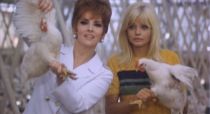
Marco (Jean-Louis Trintignant) and his wealthy wife Anna (Gina Lollobrigida) run a futuristic chicken farm aided by their young secretary, Gabrielle (Ewa Aulin). Having sacked the workers and gone fully automated, the farm now turns record profits. But beneath the shiny veneer of capitalist success, Marco hides some rather sinister secrets. He spends his weekends at a discreet hotel with a string of hookers, playing kinky sex games that seemingly end in their deaths. On top of that, Marco plots to murder Anna and make off with her money, having begun an affair with the luscious Gabrielle. Two unexpected events throw a spanner in his meticulous plan. He grows paranoid that the advertising executive (Jean Sobieski) hired to promote the poultry plant is romancing Gabrielle on the side. Then a freak accident at the lab produces a new breed of grotesque headless, wingless mutant chickens. While Anna and the company stockholders see them as a potential goldmine, Marco is repulsed by the mutants and aims to see them as dead as his wife.
Although the above synopsis has been re-assembled for clarity’s sake, La morte ha fatto l’uovo or Death Laid An Egg forgoes linear storytelling in favour of a fragmented narrative juxtaposing past and present events with seemingly unrelated incidents, pop art imagery and philosophical musings. The bravura opening montage of seemingly random, unconnected events sets the tone: at the busy hotel a middle-aged man prepares to commit suicide. The man in the room next door eavesdrops on a couple having sex. He sneaks a peek from the balcony and sees the woman knifed to death by a killer in giallo regulation black gloves. The killer is Marco. Bruno Maderna supplies the suitably disorientating score, a mix of easy listening, jaunty Italian pop and eerie dissonent sounds - a nightmare you can groove to.
When giallo horror-thrillers exploded in Italy a wide spectrum of filmmakers were drawn to the form. Some were devotees of classic Hollywood thrillers and sought to update their mechanics for a more permissive age. Others simply revelled in sadism and sleaze. And then there were those who found a new freedom in the form to craft wildly experimental narratives touching on politics, semiotics and psychology. Former documentary filmmaker Giulio Questi fell into this latter group. Having already assembled an agit-prop spaghetti western in Django Kill! (1967), he set his sights on subverting another popular genre with this audacious, ingenious, if somewhat infuriating giallo. For all its innovations within the giallo form, the film arguably draws heavily on the work of art-house heroes of the time. The influence of Jean-Luc Godard is apparent as is that of Luis Buñuel, particularly an amusing party scene where the haute bourgeoisie guests attempt to redefine themselves by destroying their prized possessions.
So what is it all about? Well, the film draws none-too-subtle parallels between the scheming characters, the monstrosities wrought by the hi-tech chicken farm and the gradual mechanization of modern life which has led to the dehumanization of society. The opening credits roll over images of chicken foetuses forming from billions of micro-organisms, perhaps illustrating the coldly scientific view of society held by the bourgeois psuedo-intellectual characters. Almost all the protagonists are prone to intellectualizing about dissecting things, whether that means increasing productivity at the farm, selling the public on the importance of eating chicken, self-improvement, or simply finding out what makes a beautiful enigma like Gabrielle tick. The implication is that by dismantling the natural order of things and indulging strange sociological experiments, society creates malformed mutants. One reason why Marco is so unnerved by the headless chicken creatures might be that they physically embody his psychological state of mind.
Like a lot of post-war, post-Neo Realist Italian cinema, the film has a Marxist bent. It’s all the rich folks' fault, see. However, beneath this right-on attitude lies a rather reactionary disdain for everything modern and progressive as the root of all evil. The sullen, hostile working class characters on view aren’t drawn any more sympathetically than the chic bourgeois schemers. Indeed the film is so fixated on the idea of glamorous upwardly mobile types as evil perverts, it lets worthier targets like heartless corporations and corrupt government off the hook. What keeps the film vivid and exciting, aside from Questi’s eye-catching technique, are the surprisingly distinctive performances. Nouvelle Vague icon Jean-Louis Trintignant, Fifties sex bomb Gina Lollibrigida (in arguably the most avant-garde movie she ever made) and Swedish beauty Ewa Aulin are all excellent as attractive yet unfathomable characters whose relationships remain ambiguous right up until the enigmatic, yet satisfying payoff.
Italian director who moved from film criticism to making political documentaries during the 1950s. Was an assistant on Fellini's La Dolce Vita before directing his two best known features in the late 60s, the unsettling western Django Kill! and the very strange giallo Death Laid an Egg. Worked mostly in Italian TV throughout the 70s and 80s.




 Display comments