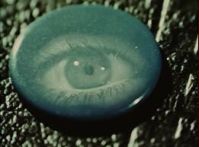
Joe (Jack Bittner) has secured a lease on a new apartment where he plans to live alone since breaking up with the love of his life. But there arises a problem: how will he make his money for the upkeep of the premises with no visible means of support? He has no job, no prospects, and no future until, that is, he looks into the mirror and notices the image of his lover reflected in his eye; this gives him a brainwave. He will charge people visiting the place for a brand new dream which they can experience right there...
In spite of the big names in art and surrealism who assisted Hans Richter in the making of this film, contributing their own ideas to the various segments representing the dreams for sale, more of a footnote than any major work this was a film that has languished in obscurity for years, and even now it is more widely available not many have given it a chance since it sounds so difficult to get along with. Names like Man Ray or Marcel Duchamps as involved here make this seem a daunting propsosition, but should you brave the worry that you would not know what the hell was going on, this was not as unfriendly as all that.
What it was, mind you remained fairly impenetrable, but then again so were the majority of dreams you would conjure up in your own mind of an evening, so in that manner you could observe they had designed something accurate as to what their aims had been. Unfortunately it also made for something of a slog because what you could appreciate and ponder in an art gallery was not always something judged a success on film, and if Salvador Dali and Luis Buñuel had helped to spread their global renown with their early cinematic efforts the same could not be said in this case.
So what was on offer? Artist and commentator on the Dadaist scene Richter provided the framing, with our friend Joe who begins by supplying the reveries to his customers, first up being a swooning Max Ernst construction where a meek man lives out a romantic fantasy away from his domineering wife, then Fernand Léger's vision of moving shop dummies, another romantic vision, which sees one of them riding an exercise bike. These are fair enough and like the rest mildly impressive on their small resources, but you could be forgiven if restlessness had set in by this point, no matter that John Cage was one of those providing the musical accompaniment.
Man Ray was up next with some baffling drama which featured a new kind of cinema where the audience adopts the position of the man on the screen, vaguely amusing but again, the point passes you by in anything other than playful style, then it was time for Marcel Duchamp's captivating mobiles which were fine even if they didn't propel the film forward any. Alexander Calder offered what could best be described as puppets for his ballet and circus themed shenanigans, once more not bad to look at but precisely the value of filming them was hard to fathom, then finally Richter made his presence felt with Bittner acting out the drama of a man who is shunned when he turns completely blue, all under the name Narcissus. Rather than appear daring now, Dreams That Money Can Buy came across as quaint, charming to a degree but more of a relic of a bygone age than a living, breathing artwork. Worth seeing if you had any interest in these artists, but not much more.