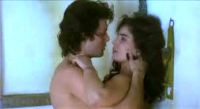
Jessica (Blanca Marsillach) watches enraptured as her saxophonist boyfriend Johnny (Stefano Madia) lays down some smooth grooves in the recording studio. Afterwards she licks the sweat off his face while he fondles her breasts, annoying his catty producer Nicky (Bernard Seray) who walks out in disgust. So Johnny promptly shoves his sax between Jessica’s legs and performs the screen’s first musical blow-job. Now that’s jazz.
Scenes like the above are one reason why few people took this film seriously back in the day but in actual fact The Devil’s Honey was a last bid for respectability from Lucio Fulci before finally resigning himself to forever being Italy’s godfather of gore. Although his name remains synonymous with maggot-ridden zombies and splattery deaths, in the past Fulci had proven surprisingly adept at exploring erotic themes with psychological acuity and staging sensual scenes, notably the psychedelic striptease in Perversion Story (1969), the fevered lesbian dream sequences in A Woman in a Lizard’s Skin (1971), those sweat-sheened dance scenes in Murder-Rock (1984), and pretty much every scene with Barbara Bouchet in Don’t Torture a Duckling (1972). He even pulled off a rare intelligently saucy sex comedy with La Pretora (1976) starring the divine Edwige Fenech.
With The Devil’s Honey, Fulci sets out to map the fine line between sexual obsession and sheer madness in a manner often akin to the ludicrous 9 1/2 Weeks (1986). Although it is debatable whether Fulci’s style anticipates the glossy pretension of Adrian Lyne or simply apes it, there are echoes of Mickey Rourke in the nitwit pseudo-philosophy practiced by nitwit Johnny whose relationship with Jessica is closer to abuse than love. Frankly, Johnny is a total douchebag. He forces Jessica to masturbate him whilst speeding on his motorcyle, forces her into uncomfortable anal sex saying she’ll learn to love it, shoves a loaded gun between her legs and finally seems less than happy to learn she is pregnant. Johnny also urges Jessica to think of him as her master, a demand echoed in the parallel plot concerning outwardly respectable surgeon Dr. Wendell Simpson (Brett Halsey).
It seems the good doctor is cheating on his wife Carol (Corinne Clery) with a young call girl who obligingly smears red nail polish over her privates to his evident delight (“You’re so docile. You need a master!”) For her part, Carol seems less upset about Simpson’s infidelity than his inability to satisfy her in the same way. Shortly after learning his secret, she demands they have sex (“I’m sick of being respected. Treat me like a whore. That’s what I am. I’m your whore!”) but after his poor performance, promptly files for divorce. Even those sympathetic to Fulci’s aims have to admit his sexual politics are rooted in the Stone Age, implying that without a strong male hand, a woman’s ravenous sex drive will drive her insane.
The two plot strands come together after Johnny bumps his head on a rock and dies on the operating table, because Simpson is so upset over his imploding marriage he botches the surgery. Thereafter, a now completely unhinged Jessica kidnaps, imprisons and tortures Simpson whilst also wandering around naked, tongue-kissing him and having him perform enthusiastic oral sex. See also Emmanuelle e Francoise (1976) for similarly unorthodox “tortures” that reveal more about the macho mindset of Italian exploitation and its combined fear and fascination with feminine sexuality. Eventually a mutually beneficial sado-sexual relationship blossoms between captive and captor: Simpson becomes a willing submissive while Jessica finds the control she never had in her relationship with Johnny. As wacky as all this sounds such scenes prove the most successfully realised part of the film, thanks in large part to an impressive performance from Blanca Marsillach, who starred in an earlier Fulci-scripted erotic drama called The Trap (1985). Brett Halsey, an Italian exploitation veteran of everything from spaghetti westerns to sex comedies and horror films including a reunion with Fulci on the risible A Touch of Death (1988), somehow manages to ground his increasingly ridiculous role but the film sadly wastes Corinne Clery, star of Hitch-Hike (1977) and The Story of O. (1975) and a fine if underused Bond girl in Moonraker (1979), who exits early but not before disrobing.
In another life Fulci could have been a filmmaker more like Luis Buñuel given he shared a similar penchant for scandal, surrealism and disdain for the bourgeois. Unlike Buñuel however, deep down Fulci shares the same values of the establishment he purports to scorn, a belief that people in the arts are amoral deviants, passion is only a step away from psychosis, and women are hysterical nymphos. It is these problematic aspects in his work, not any lack of talent, that kept him confined to the exploitation ghetto.
Italian director whose long career could best be described as patchy, but who was also capable of turning in striking work in the variety of genres he worked in, most notably horror. After working for several years as a screenwriter, he made his debut in 1959 with the comedy The Thieves. Various westerns, musicals and comedies followed, before Fulci courted controversy in his homeland with Beatrice Cenci, a searing attack on the Catholic church.