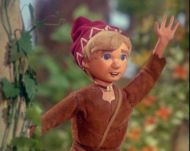
Here is the Great Ak (voiced by Alfred Drake), ancient and all-knowing protector of all forest creatures around the world. He has come to chair a secret meeting of the council of Immortals. Queen Zurline (Lynne Lipton), the Lord of Lerd, the Gnome King, Peter Nook (all voiced by Peter Newman), the fearsome bat-winged Commander of the Wind Demons (Larry Kenney), the lovely fairy Necile (Lesley Miller) and several others have gathered to decide whether the mortal known as Santa Claus (Earl Hammond) should live or die? Merry Christmas!
Don't worry kids. Given we are talking about Saint Nick, the outcome was never really in doubt. However, that does not prevent The Life and Adventures of Santa Claus from being one of the most charming and inventive holiday specials ever made by stop-motion maestros Arthur Rankin and Jules Bass. Beginning with the delightful Rudolph the Red-Nosed Reindeer (1964) Rankin-Bass' annual animated offerings grew into an American TV tradition. Their stories, often clever and subversive, grew increasingly complex as years went by. Based on a children's novel by L. Frank Baum, creator of The Wizard of Oz, The Life and Death of Santa Claus is an intriguing attempt to combine Christian ethics with the pagan fantasies that lie at the roots of our Christmas traditions.
The debate among the Immortals provides the framing device, as Great Ak narrates how an orphaned baby was found in the fairy realm and raised by the lioness Shiegra and the fairy Necile. In a moment of disarming pathos, typical of the Rankin-Bass holiday output, Necile is driven to adopt Young Claus (J.D. Roth) after lamenting eternal youth and beauty are somewhat hollow without knowing the love of a child. Indeed children and their right to happiness is the story's central theme, as Great Ak gives Young Claus a glimpse of the troubled mortal world. Flying around the globe they see peasants suffering in medieval Europe, little boys being trained for war in feudal Japan, and beggar children starving in a street market somewhere in the Middle East. As well as a strong anti-war message, the film puts forth the notion that the purpose of life is striving to leave the world a better place than when we found it. To that end, children are depicted as seeds that dealt with tender, loving care will blossom and influence future generations.
While it sounds heavy-handed, screenwriter Julian P. Gardner outlines these themes with a welcome light touch, including the usual jaunty musical numbers and typically quirky Rankin-Bass humour. Eventually Claus, Shiegra and Tingler the billingual Elf (Bob McFadden) start a new life in the Laughing Valley where, as the years roll by, our hero morphs from lithe, Peter Pan-styled youth to the jolly, fat, white bearded icon we know and love. He befriends a little orphan named Weekum (Joey Grasso), for whom he builds the world's first toy. When other children start asking for toys, Claus hits on the idea of giving gifts to reward good behaviour. This revolutionary idea angers the King of the Agwas (Earle Hyman), a race of freaky horned monsters who thrive on the evil energy of naughty kids. These bad boys kidnap Claus, steal his toys and imprison him in dark cave with a scary, enormous snake and spider. Do you suppose Tim Burton ever saw this film? Anyway, the outraged Immortals wage a full-on mystical war against the evil Agwas, with the future of Santa and the world's children at stake.
These days seasonal television movies are synonymous with stupid slapstick and saccharine mush. Here, things get delightfully weird as the plot takes a left turn into a full-on, Tolkien-style fantasy action romp. Dainty little Necile disintegrates an enormous, impressively frightening dragon with a wave of her magic branch. Peter Nook shrinks a horrible cyclops down to tiny size. Great Ak zaps flying demons back to hell. What self-respecting child wants to watch Tim Allen or somesuch yukking it up in a Santa Suit when there is cool stuff like this onscreen?
By this stage, the animation at Rankin-Bass was as accomplished as that of the great Russian stop-motion masters. The fluttering fairies, frolicking jungle animals (who knew Santa hung out with elephants and monkeys when he was a lad?) and marvellous monsters (some worthy of Ray Harryhausen) are beautifully realised. That nonconformist Rankin-Bass spirit allows for some welcome surprises. Notably that the Commander of Wind Demons goes from being outraged at the thought of a mere mortal gaining eternal life, to becoming Santa's staunchest advocate, thus teaching youngsters to never judge by appearances. Even scary, vampire-lookalike monsters have their nice side. And in case you are wondering, the film also answers such age-old questions as where that sleigh and reindeer came from, how Santa decided to slide down chimneys, why he puts presents in stockings and the invention of the Christmas tree. There you go, in fifty minutes, this satisfies all your Christmas needs.