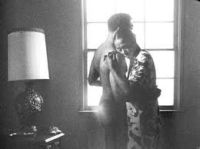
Stan (Henry G. Sanders) lives in the Watts district of Los Angeles, and today he is chastising his elder son for not sticking up for his younger son, who has been beaten in a fight. Life is hard for him, and he is increasingly dissatisfied with his lot, especially the job he holds at the local abbatoir where he slaughters sheep day in, day out, not what he always wanted to do but he needs the money. His wife (Kaycee Moore) helps give him a reason to stay on the straight and narrow, but it's getting so he cannot satisfy her anymore...
Charles Burnett is for some people the finest African American filmmaker who ever lived, even above Spike Lee who may be higher profile but whose in your face style many find offputting. Burnett, however, played it far more subtly to make his points about the society his characters existed in, as was seen here in his debut feature, made around the time he had graduated from film school and still showing evidence of a very low budget. That meant grainy, black and white camerawork, sound which was muffled enough not to pick out every word that was said, and locations grabbed wherever he could, without a hint of a permit.
The results were far from slick, but Burnett used that to his advantage with one of the most convincing depictions of lower class family life of the period, a documentary approach only contributing to what was nevertheless a compassionate take on the African American poor. The much-put upon Stan is struggling, we can see that, as the criminal element in the community attempt to get a grip on him, and we can see that his eldest may not be as strong as his father in resisting their lure. Although Stan is offered the chance to make more money by getting involved with some dodgy geezers, he manages to deflect their attention.
The trouble is in spite of how noble he feels he is being, he still frets that he is at the bottom rung of society's ladder, no matter how much he protests that he is not as badly off as some of the locals. Part of that is that while he may have a job unlike many, that entails a soul-destroying task of executing the animals, an activity Burnett was not shy about showing us in all its gory detail - be warned that there are those viewers who cannot watch the film when it is so graphic in its slaughter, more of the documentary method on display. His wife tries to understand, but he's pushing her away thanks to his plummeting self esteem, and we worry he is heading for a breakdown.
Burnett returned time and again to the imagery of children playing in the streets and wasteground around Watts, and there was a motif there too: the kids will throw things at each other, or play fight, or just plain square off against each other, and someone will end up hurt or crying. No matter how often this happens, none of them seem to learn from it, setting the course of events into action over and over, mirroring the daily grind of their parents with women chained to the kitchen sink and men muddling through even as the odds of their getting ahead dwindle thanks to circumstance or their own short-sightedness. There were complaints that a plot was hard to make out in Killer of Sheep, but there is one there, as the film built up a selection of events to offer a narrative to Stan's anguish, not that he spent his days staring at the ceiling, but you can tell he is not in the best state of mind. A soundtrack of black American singers of many generations provided a commentary, at times ironic, on what we see; rough and ready, easy to miss its important points, but with a truth to what we saw.