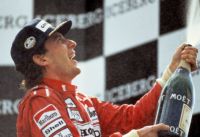
Ayrton Senna is renowned across the globe as one of the greatest Formula 1 racing drivers who ever lived, and his tragic demise in 1994 sent shockwaves through both the sport and around the world, where he was one of the most famous racing celebrities of his day. He had come from a wealthy Brazilian family and early on had been keen to take up the profession thanks to an interest in go-karting which developed quickly into a chance to drive as a career. But his life was not without controversy...
Senna, the movie, turned out to be one of the most popular documentaries Britain ever produced, breaking box office records for a genre, the sporting doc, which was not always considered a big moneymaker outside of the direct-to-DVD market where many compilations of such highlights were the more obvious home for such works. But director Asif Kapadia recognised a story as big as his subject's would be ideal for the big screen treatment, if only for the footage of the drivers bulleting along the track seen through the in-car camera, and he was right, although even then his film was equally as potent on the small screen.
This was down to emphasis on the humanity in Ayrton Senna's tale, unavoidable considering how it ended, but not approached here in a lurid fashion. Rather it was treated sensitively, so that you were always aware this life was not going to end well, making every moment captured on a host of clips all the more precious. As with many documentaries, it was true that perhaps the filmmakers attempted to build up the drama of actual events to create a more cinematic mood, so here Alain Prost was shown to be the villain of the piece when in real life the rivalry he had with Senna - cool-headed strategist versus spiritual rebel - may have had its ups and downs (and collisions), but he was not a genuine bad guy.
Understandably there were those watching this who felt it skirted over points and races that they would have liked to have seen more of, but Kapadia skillfully assembled the material he had into an overview which in the early stages looked to be rather haphazard, but as it wore on began to take shape. A clip of Senna with a Japanese TV presenter appears to be included as a bit of fun, illustrating the man's charm over the swooning ladies, but proves to be plot foreshadowing when two Japanese Grand Prix loom large in his later life. Similarly, when we see him with a Brazilian presenter on a crazy-looking TV show, she becomes his girlfriend - but significantly gives him kisses for each year up to 1993.
Significantly because in 1994 Senna met his untimely death, and the last act of the film is understandably grim and sorrowful, even if you are familiar with the way events played out and that awful footage of his car hitting the wall of the circuit for reasons never entirely explained. The whole weekend at that San Marino Grand Prix is notorious as the darkest one of the whole sport, or at least one of the most notorious, having seen another driver, Roland Ratzenberger, suffer a fatal crash which horribly augered Senna's fate shortly after. Although not quite a hagiography - an interview with Jackie Stewart uncomfortably points out Senna's tendency to bump other cars - in these latter scenes the film builds him up to mythic status, yet whatever you thought of the champion before, even if you were sceptical, you have to admit the way it all finished for him was desperately sad and that he was a great ambassador for the sport, not only for his driving but for his tireless charity work as well. Offering much to think on, Senna was one of the finest sporting documentaries of its kind. Music by Antonio Pinto.
[The Region 2 DVD, and the Blu-ray, include a host of featurettes to back up the main feature, with interviews galore and more clips from the archives.]