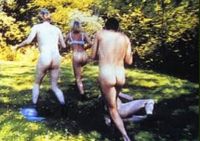
Middle-aged Karen (Bodil Jørgensen) is trying to get away from things for a while, but she's finding it financially difficult, so when she visits a posh restaurant she can only afford a salad, something the waiter only slightly hides his disdain for. But across the room a group of people catch her eye, a young woman trying and failing to marshal her mentally handicapped charges, two young men who are beginning to be disruptive to the other diners. One of them, Stoffer (Jens Albinus), latches onto Karen and she offers to assist him outside - but she has a surprise coming when she does.
The Idiots, or Idioterne as it was known in its original Danish, was director Lars von Trier's entry into the cinematic movement known as Dogma 95, where he joined with three other local directors and drew up a list of rules for making a movie that could be admitted into their exclusive club. There were a spate of such things taking their lead from all over the world for a while, but it would be a stretch to say any of them were absolute classics, with even the best hard to fathom if they'd be any better without the restrictions they took upon themselves.
Von Trier, being no stranger to controversy even at that stage, chose the most headline-grabbing plot for his outing, where a bunch of disaffected young people decide to rebel by confronting society with their attitudes towards the mentally disabled. Stoffer, their leader, coaxes them into acting as if they were in that condition, taking them on factory visits, charity drives and swimming pool excursions among other things, as well as smaller scale pranks on individuals, sometimes the actual members of the group. They all live communally in a large mansion owned by Stoffer's father, as if to underline they have the free time to arse about rather than do anything constructive.
Except Stoffer has them thinking that's precisely what they are doing, in the vein of some kind of experimental theatre group rather than the annoying awkward squad they actually are. Wed to this were von Trier's concerns about how far you go into acting before you are actually living out the performance, most notoriously in a sequence where the commune has an orgy and the director persuaded to them to have sex on camera for real, but in more abstract ways as well. Karen is more an observer here than a participant, but we find out why she needed someone new to join up with at the end of the story, supposedly emotional but in effect rather reductive and frankly hard to believe.
Von Trier did make motions towards comedy here, and in truth there were a few scattered laughs at the Idiots' antics, but in the main it wasn't his best work, not because it was insulting as he managed to infuse this with enough of a serious intent to just about get away with his characters' behaviour, but more because it was a one joke movie. Once you had watched the first twenty minutes or so, it was clear there was nowhere else to go with this idea, yet it sprawled out for around two hours of would-be provocation, only you'd imagine the sole audience members to take this sincerely would be those to whom artistic confrontation was a legitimate way of engaging with the mind. Subtlety was not the strong point here, and as it descended into a load of sixties-style anti-bourgeois posturing British viewers of a certain age would be reminded of the type of kid who thought it hilarious to do Joey Deacon impersonations. Imagine that with a dubious message and you'll have difficulty going along with von Trier's trickster design.
Notoriously eccentric Danish writer, director and producer, a graduate of the Danish Film School, who has capitalised on international acclaim and disdain in equal measure. Thrillers Forbrydelsens Element and Epidemic started the ball rolling, with distinctive war drama Europa really setting von Trier up as a talent to watch.
Breaking the Waves, the first in a series of victim stories, won the Grand Jury Prize at Cannes and his fame spread, especially as he had teamed up with three other directors to create the Dogme '95 rules of filmmaking - controversial The Idiots was von Trier's result. Then Dancer in the Dark, a musical starring Bjork, proving he was anything but predictable, and Dogville, a scabrous attack on American small town life.
He was next involved in The Five Obstructions, a documentary which revealed much about his methods. Then, a thematic follow-up to Dogville, slavery drama Manderlay, which was followed by little seen comedy The Boss of It All and most controversially, his relationship goes to hell horror Antichrist.
His drama Melancholia won its star Kirsten Dunst Best Actress at Cannes, but he was ordered to leave after a press conference faux pas, then returned with the patience-testing, two part Nymphomaniac. After a gap, he made bleak horror comedy The House That Jack Built, to more controversy. On television, he created the superb horror series The Kingdom, and he frequently casts Udo Kier.