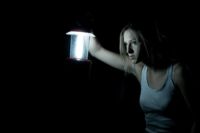
Laura (Florencia Colucci) is accompanying her father Wilson (Gustavo Alonso) to a remote country house where they have been asked by a friend of the family, Nestor (Abel Tripaldi), to clean up the place before he sells it. As it is growing close to dusk, they decide to sleep in the house so they can begin work the next morning, but Wilson finds it far easier to settle down for the night than his daughter. She keeps thinking she hears strange noises from outside, then inside, the building - who or what could they be?
The idea of a film that takes place over the whole of an unbroken take - a feature length movie, that is, not a short - is for whatever reason something that became very desirable for certain filmmakers over the years. Alfred Hitchcock tried it with Rope and Under Capricorn, whereby he would hide the cuts every ten minutes or so with an item of camera trickery, but the first real progress with a genuine unbroken take for about ninety minutes or so was Russian Ark, a dreamlike historical drama and impressive technical achievement to boot.
The Silent House, or La casa muda as it was known in its native Uruguay, was an attempt at this in the horror genre, proclaiming from the beginning that this was based on a true story in a Blair Witch Project style, which the following tale resembled in style if not quite in content. However, you could see that for all their boasts this was a single take effort there were instances where it would have been simple to supply a cut or two - or more - to make this easier to organise, and besides, director Gustavo Hernández was listed as editor in the opening credits, suggesting he was not quite on the level with his claims.
None of this would matter if the chiller was appropriately engrossing, and for a while it was, but eventually you began to notice that the restrictions of the format meant there was not much star Colucci had to do but anxiously wander around the house of the title lantern in hand, and occasionally be spooked by some contrived jump moment. In truth, if it were not for that innovation in technique, this would be anaemic indeed, as we got to know very little about the small cast of characters and might have found ourselves contemplating why Laura didn't get the hell out of there sooner, not to mention that this didn't convince as an accurate representation of an actual event.
There was a big revelation at the end, evidently intended to have the viewers gasping as they managed to put two and two together and be shocked at the abuse that had led to this state of affairs, but instead of throwing events into a sharper relief, what you got was pretty hard to believe that something such as that would have been blocked out by Laura to the extent that she was not aware of what was really happening. Better to be entertained by the creeping around that led up to that anticlimax, which to be fair was well enough orchestrated to keep you intrigued even if it did have you rolling your eyes when the final twist arrived. Still, that nagging feeling the whole one take style was being utilised to mask a plot that was wispy to the point of blowing away in a stiff breeze never quite left it, even in the scenes where you were in the dark, literally, about the truth. Music by Hernán González.