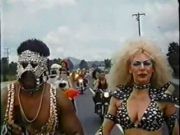
Punk rockers run riot in Mexico! An in-your-face rockantolero soundtrack by Three Souls in My Mind blares over cool graffiti-on-the-walls opening credits, before a group of gun-toting nuns rob a bank. Of course they aren’t nuns at all, but big bosomed, bigger haired biker chicks led by fishnets-and-studded-leather bikini clad punk princess, Wildcat (Princess Lea). Escaping with three thousand pesos, the gang of cycle sluts and cotton candy mohawk road warriors leave a trail of bullet-ridden cop corpses in their wake. Wildcat uses the money to buy guns, aiming to spring out of jail her gang leader boyfriend, the glitter-masked wrestler Tarzan (El Fantasma). This she does by home invading the warden’s house and having her punk cronies gang-rape his wife and her friends. When the warden proves too busy screwing hookers to take their threats seriously, Wildcat sends him his wife’s severed hand in a gift box to prove she means business. Tarzan is promptly set free and leads his punks on a cross-country rampage of rape, murder and wanton destruction, until mucho macho middle-aged cops Marco (Juan Valentin) and Javier set out to stop them.
Masked wrestlers, or luchadores, have been a staple of Mexican screen entertainment since the early exploits of El Santo and his compadres Blue Demon, Mil Mascaras, et al. Although later luchadores movies grew gorier and raunchier, by the early Eighties the genre was starting to look old hat. Intrepidos Punks seemingly aimed to turn the whole genre on its head. Pro-wrestling stars El Fantasma and Princess Lea (see what they did there?) are definitely centre-stage but their amoral exploits have more in common with the Droogs from A Clockwork Orange (1971) or the delinquent freaks from Class of 1999 (1984) than the righteous, civic-minded Santo. This might have been too much of a shock to the system for the Mexican mainstream since while the film was made it in 1980, it was not released for eight years although seemingly successful enough to warrant a sequel: La venganza de los punks (1991).
While the relentless parade of rape, torture, maiming and murder is often offensive, the self-consciously campy tone is closer to the early, outrageous comedies of Pedro Almodóvar, only nowhere as accomplished. For example, during the home invasion sequence, a punk rock band appear out of nowhere to provide a driving beat throughout the sexual assault. Nevertheless there is a whiff of heavy-handed moralising about the scene, given how earlier these women boasted about their infidelity. Tarzan and his punks may be thoroughly rotten bastards but the the authority figures on view are scarcely any less casually corrupt, sleazy or sadistic. Marco and Javier are largely ineffectual heroes, forever grinning, giving each other high fives or joking about shagging each other’s sisters. Star Juan Valentin had dual careers as a popular ranchera singer and Mexico’s answer to Charles Bronson, but it is hard to imagine any film starring old old stony face delaying his confrontation with the villains until the last fifteen minutes. Even then, our less-than-dynamic duo rely on another set of federal agents to get them out of a jam.
The film consists largely of repetitive scenes where Tarzan and friends - who have colourful names like Pirate and Caligula - indulge in sex and drug fuelled satanic orgies, bouts of Russian roullete, demolition derbies and of course, mindless violence. A petrol pump attendant is set on fire and a gangster gets strapped to an exploding tanker. Princess Lea also pops her top for a sweaty coupling every ten minutes or so. It is silly, trashy, comic book stuff, too over the top to be truly transgressive, although any real former punks watching may well wonder why some cultures took their posturing at face value and assumed all listeners were violent degenerates.