Charlotte (Émilie Dequenne) is driving through Europe towards the sun, or at least until her collection of CDs runs out, but in these out of the way places and this chilly, inhospitable landscape she wonders if her tough girl posturing will help her when a woman on her own here could be quite vulnerable. That is why when she notices a group of bikers in her rear view mirror who are bearing down on her car she's only too pleased to stop to pick up a hitchhiker (Benjamin Biolay), and the bikers whoop as they pass, but go on their way regardless. Yet Charlotte was right to be concerned...
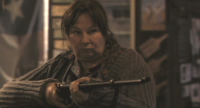
It was only a matter of time before someone offered the Belgian character actress Yolande Moreau the lead in a horror movie, and in this little item of the French horror new wave she got her chance to play the murderous villain. Her character, an owner of a roadside cafe in the middle of nowhere, at first comes on like one of the good guys, as Charlotte and the hitcher have stopped there only to be physically threatened by the bikers who show up shortly after. Just as things are about to get seriously grim, she appears toting a shotgun, thereby scaring the would-be assailants away.
But as if that gloomy landscape has not alerted you to it, things will get seriously grim anyway as the hitcher disappears into the toilets and doesn't come back out. Charlotte becomes concerned, but when she asks a few questions she doesn't make any progress in finding out what happened to the man, not even when she asks a local retired police detective (Philippe Nahon) who in an example of the regular profanity in the movie sports a t-shirt with a dubious slogan on it (in English). Ah, but all is not as it seems, and Charlotte should have forgotten about the missing person lest she became a missing person herself.
But she cannot leave it alone, leading to the main stretch of the plot, sort of a Gallic spin on a cross between The Texas Chain Saw Massacre and Night of the Living Dead. If you wonder why the film world really needed such a thing, first time writer and director Franck Richard made a fair case for himself and his creation, as while Charlotte did end up irritatingly passive after the initial half hour of her hard as nails persona, Dequenne had nevertheless offered us enough reasons to care what happened to her and wish to see the woman prevail. Prevail against what? Against Moreau's mean mother and her bloody brood.
The French (and Belgian) rural landscape informed quite a few of the new horrors of its era, effectively transporting the backwoods shockers of the seventies that emerged from North America to a twenty-first century European setting. The Pack was neither the best nor the worst of them, but featured enough eccentricity to sustain what was a fairly brief running time, even if those quirks were derivative of other, more celebrated works. So if the sense of deja vu never left the experience of watching it, the strange presence of Moreau, so often used for novelty in her movies, was well deployed as she orchestrates the other characters into falling victim to her drive to sustain her monstrous family. There wasn't much to this but recommending townies not to stop for anyone should they be travelling through quiet countryside, but it didn't outstay its welcome, and provided some memorably horrible scenes, as it had set out to do.