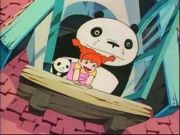
Left home alone when her grandma has to go away for a few days, bright little Mimiko (voiced by Kazuko Sugiyama) proves perfectly capable of looking after herself. One day Mimiko discovers a Baby Panda (Yoshiko Ota) asleep on her doorstep and is equally delighted when its big, friendly, chatty Papa Panda (Kazuo Kumakara) arrives on the scene. Papa Panda does not think it is right for a such a little girl to be all on her own, so Mimiko invites him to stay while she in turn becomes a surrogate mother to Baby Panda. Together this unconventional family share all sorts of misadventures, to the bemusement of the local townsfolk. Then Mimiko learns the pandas escaped from the zoo and are wanted by the police.
In 1972 Japanese Prime Minister Kakuei Tanaka was on a visit to Beijing when the Chinese government presented him with an unusual goodwill gift: a pair of pandas named Ran Ran and Kan Kan. On their first day in residence at Ueno Zoo, the cute twosome drew an astonishing crowd of fifty-six thousand visitors and soon sparked a nationwide panda craze that in turn spawned such anime as Panda’s Great Adventure (1973) by the great animator Yugo Serikawa and the Sino-Japanese co-production Taotao the Panda (1981). Panda Go Panda got off the block first and is especially notable because it was written and storyboarded by Hayao Miyazaki and directed by his future Studio Ghibli co-founder, Isao Takahata. The pair incorporated ideas left over from their aborted Pippi Longstocking project, hence the presence of a feisty and fearless, pigtailed little heroine. Mimiko shares a spirit of self-reliance in common with Astrid Lindren’s iconic child heroine and Miyazaki’s script echoes the Swedish author’s belief that an unconventional family can be as healthy and positive as a standard one.
Takahata and Miyazaki explore the parent-child relationship seen through a child’s eyes, as Mimiko becomes a capable surrogate parent (disciplining Baby Panda, but not too harshly, and even risking her life when he falls in the river) and touchingly teaches Papa Panda how a good daddy wears a hat, smokes a pipe and gives lots of hugs. She basically plays house throughout the film. At one point Mimiko packs a bento box and sends the poor befuddled bear off to work, but changes her mind when he looks so crestfallen. However, this seemingly innocuous plot point pays off with a very funny gag towards the finale. The story is simple without being simplistic and full of endearingly surreal gags mostly centred around the reactions of local folks to these grinning, gargantuan, fun-loving fur-balls, but also including Baby’s surprise use of judo on a big, bullying dog and Papa riding a packed train to work alongside startled commuters.
Manga Entertainment’s region 2 DVD includes the sequel, Panda Go Panda: Rainy Day Circus (1973), on the same disc. Here the surrogate family expands to include a tiger cub (again voiced by Yoshiko Ota) who has run away from the circus, culminating in a clever confrontation between Mimiko and the mother tiger. Whereas the first film foreshadows Miyazaki’s later classic My Neighbour Totoro (1988) with the antics of its cuddly characters and a handful of plot points, the sequel anticipates his recent Ponyo on the Cliff by the Sea (2008) as a flood turns the town into a submerged wonderland. After chiding the cowardly and clumsy circus owners for being bad parents, Mimiko helps the circus animals drive their own train out the flood. It’s a lively and inventive adventure, but did not spawn a nationwide tiger craze to match the panda-mania (pandemonium?) that came before. In fact, the 1980s saw Japan obsessed with another kind of bear, the Koala, and naturally enough anime movies followed.