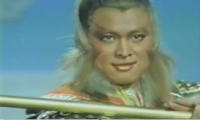
Written by Wu Cheng-En in the sixteenth century, “Journey to the West” is one of the four great works of classical Chinese literature and remains a cinematic staple throughout the Far East. There have been scores of adaptations made over the past one hundred years, from the Shaw Brothers classic The Monkey Goes West (1964) to the revisionist masterpiece A Chinese Odyssey (1995), the anime favourite Alakazam the Great (1960) and the sci-fi retelling Starzinger (1978). New Pilgrims to the West, remains among the more obscure versions for some reason despite being a fairly lavish production featuring a rather starry cast. It opens in traditional fashion with a battle in heaven between the super-powered simian and an array of outlandish celestial beings. Sun Wu Kong the Monkey King (Lau Seung-Him) has mastered all known magic and martial arts, plus the ability to transform into anything he pleases. In his arrogance he sets out to make himself ruler of heaven and earth until almighty Buddha challenges the upstart to leap across the universe - which turns out to be the deity’s enormous palm.
Thereafter the Monkey King lies imprisoned in stone for three hundred years until the Goddess of Mercy (Huangmei opera star Ivy Ling Po, recreating her role from the classic 1963 Shaw Bros. movie) tasks pious monk Tripitaka (Leung Sau-Gun) to set him free. It will be Monkey’s mission to protect Tripitaka as he embarks on a perilous pilgrimage to Gandhara in India, where he hopes to retrieve the sacred sutras. To curb Monkey’s mischief, the Goddess affixes an iron ring around his head that constricts painfully whenever he lapses into his naughty ways. Along their journey our heroes happen across a village plagued by demons, where Monkey rescues a beautiful young woman from the lascivious magical pig Pigsy (Boon Saam, who spent the next ten years typecast as randy fat guys). A reformed Pigsy eventually joins the quest, as does repentant river monster Sandy, who bears an uncanny resemblance to shaggy-haired Seventies magician Doug Henning. He also has an alarming tendency to bust into disco moves alongside the electro-funk soundtrack.
Our bickering pilgrims are lured into a trap by bubble-permed demon brothers Gold Horn and Silver Horn, but once again Monkey outwits the enemy by impersonating their mother (kung fu movie icon Angela Mao in her final role). Later, the gang are unable to cross a vast fiery mountain without the aid of a magical fan that the legendary Princess Iron Fan (Elsa Yeung Wai-San, a staple of weird Chinese fantasies) refuses to loan. Even Monkey finds himself in a tight spot when Princess Iron Fan and her husband King Bull (Shaw Bros. superstar Chen Kuan-Tai) unleash their awesome powers.
Fans of Chinese children’s movies should cherish the name Chan Jun-Leung. He made some of the wackiest, most inspired entries in an already outlandish genre. Although New Pilgrims never scales the heights of delirious invention attained by Chan’s other loopy mythological epic, Child of Peach (1987), it remains a spirited retelling of this oft-told tale. The film is mounted on a suitably grandiose scale with optical and cel animated special effects that may be but prove consistently eye-catching and impart an epic feel, part Disney pantomime, part Cecil B. DeMille movie. Coming after the internationally popular TV series Monkey (1979) made byGodzilla veteran Jun Fukuda, this sticks closer to the celebrated source novel without really adding anything new.
As usual Tripitaka injects an overdose of pious moralising, but this is in keeping with the legend. The story is fundamentally about the all-powerful but immature monkey learning kindness and tolerance are the proper pathways towards enlightenment. Since Sun Wu-Kong so beloved by children across Asia (where he is the equivalent of Mickey Mouse, Superman and Peter Pan all rolled into one), the film emphasises his playful japes and triumph through trickery, although this arguably counteracts the underlining moral. Sun Wu-Kong is also pretty ruthless with his enemies, so traditional Buddhist values like compassion and forgiveness pretty much fall by the wayside. As a fantasy adventure this boasts fight choreography that surpasses the early Shaw Bros. effort and a certain old school charm reminiscent of The Thief of Baghdad (1940), making it all the more unfortunate few people will watch this on anything other than a scratchy bootleg print. Chan Jun-Leung followed this up with the spirited sequel: Monkey War (1985). Star Lau Seung-Him was also in the cult Hong Kong horror movie Witch With Flying Head (1977) and later produced the even more outlandish fantasy Twelve Animals (1990).