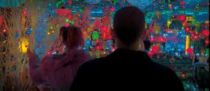
Somehow Oscar (Nathaniel Brown) found himself in Tokyo, living with his long lost sister Linda (Paz de la Huerta) in an apartment in one of the less respectable neighbourhoods. He made his money selling drugs, and was not shy about trying his own wares, as tonight when his sister went out to her job as a nightclub stripper and he was left alone to contemplate the Tibetan Book of the Dead his friend Alex (Cyril Roy) had lent him - but first he was going to get high. As he did, sailing off into a reverie, his phone rang and his other friend Victor (Olly Alexander) was making a request...
If only he had not accepted then Oscar might be with us today, ah, but he may not have left us completely as inspired by those Tibetan scribes he finds a way to hang about after his death. It's no spoiler to say that he is killed off in the first twenty minutes or so, as that is what sets up the premise, apparently inspired by too many viewings of 2001: A Space Odyssey married to an obsession with subjective camera. From the moment where Oscar is shot dead by the police in a semi-misunderstanding, we take part in his out of body experience as from before that we have been witnessing his life through his eyes.
After that, we're watching from the point of view of his spirit as it endeavours to attain some kind of rest, not to mention a level of enlightenment, so once he is very dead we undertake a journey as if we were watching his life flash before our eyes, except it takes considerably more time than that. As if filling in the gaps in our knowledge about this character, or reminding him how he reached this state, high and lowlights of his time on Planet Earth played out, so we got to see how much he loved his mother and how she was cruelly taken away from him and Linda when they were children thanks to a car crash that also killed their father.
As if that were not bad enough, their grandparents could not look after them both so they were split up, meaning, as far as can be ascertained, they don't see each other until Oscar is in Japan and invites her to join him. We're not supposed to think that his loss of life is a terrible waste, because when he was alive it was already a terrible waste as he spends nothing but thinking of how to get high and then having sex, an activity that director Gaspar Noé returned to again and again here, often very explicitly (you've heard of extreme closeups? Check out the last ten minutes of this). If he was observing what makes our existences worth enduring, then he didn't find much else but expanding your consciousness and getting laid as the main candidates.
By that measure, he attempted to simulate both experiences in Enter the Void, and the woozy camerawork may leave you less feeling as if your head is tripping and more like motion sickness, with Noé taking great delight in swooping the imagery around Tokyo, even reaching up into the sky to alight on a passing plane, interpsersing this with Oscar's past. Oddly, a recurring theme wasn't about attaining that higher level of being, but an uncomfortable preoccupation about how mothers could be sex objects, and vice versa, so the often naked de la Huerta is seen enjoying herself with her boyfriend, but also getting pregnant, having an abortion (yeah, thanks for that closeup, Gaspar) then getting pregnant again, only with a happier conclusion. Or is it? Getting stuck in the cycle of birth, life, death and rebirth is depicted as reason for mixed feelings at best, and the sense of being trapped in this world is one which strongly resonates throughout. If only the story had been as impressive as the visuals, as you don't care much for Oscar no matter what his fate. Music by Thomas Bangalter.