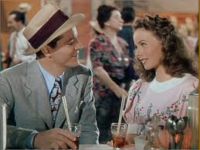
As the Frake family prepare to go to Iowa’s annual State Fair, Margie Frake (Jeanne Crain) feels “as restless as a willow in a windstorm… as jumpy as a puppet on a string.” Though Margie dreams of meeting a man as exciting as a matinee idol, her only suitor is a joyless square who has already mapped out their sterile, plastic future. Her brother Wayne (Dick Haymes) is similarly luckless in love, unable to persuade his sweetheart to accompany him to the festivities. At the state fair, while Abel Frake (Charles Winninger) frets over his prized pig and Melissa Frake (Fay Bainter) enters her preserves in competition, Wayne is enamoured with a glamorous singer called Emily Edwards (Vivian Blaine). Meanwhile Margie is smitten with handsome journalist Pat Gilbert (Dana Andrews), but both siblings are due to discover the path of true love is a bumpy one.
State Fair was the only musical the celebrated duo of Richard Rodgers and Oscar Hammerstein wrote directly for the screen. Riding high in the mid-Forties with the Broadway hit Oklahoma!, the duo were commissioned by Darryl F. Zanuck at Twentieth Century Fox to perform a musical makeover on a previously popular 1933 rural romance starring Janet Gaynor and Will Rodgers. Based on a 1931 novel by Philip Stong, who wrote eloquently about the loves and passions of farm folk, the original movie came to be regarded an exemplar of rural American life, albeit one somewhat rosy and idealised.
Such qualities were accentuated even further in the musical adaptation, which became an even bigger smash, but Rodgers and Hammerstein deftly interwove this charming slice of homespun Americana with a rather complex and generous view of romantic relationships. Margie faces that age-old dilemma for young women: romance versus practicality. She balks at her dull suitor’s description of a plastic, mechanized future just as the creators seem to recoil at the idea that such a sterile vision will soon supplant the warm, humane heartland of American rural life. In Rodgers and Hammerstein’s hands the state fair is a gleefully gaudy emblem to all their nation seems set to lose in the coming years, yet it is also a world daubed in stardust and fantasy.
Just as you sometimes find chicanery lurking beneath the fairground façade, so too do Pat and Emily prove not quite the ideal romantic partners Margie and Wayne were hoping for. The film admits sometimes people just don’t live up to our idealised expectations, but argues they should not be judged too harshly. Pat is something of a serial seducer, but is still genuinely charmed by Margie’s sincerity while Emily is equally affected by Wayne. Philip Stong knew better than to draw farm folk as naïve. Here they are certainly idealistic but often shrewd, as when Wayne puts some smarmy showbiz types in their place.
Technicolor was made for films like this and especially its fairground setting where balloons and rides are a riot of colour and one can almost taste the caramel apples and cotton candy. And was any actress quite as ravishing in Technicolor as Jeanne Crain? Crain’s success as a musical star was something of a curious quirk since she did not sing a note and was regularly dubbed by Louanne Hogan. Nevertheless her innate sweetness and luminous charm shine through as does the charisma of co-star Dana Andrews. Ironically Andrews could sing and was originally an opera star, but being unaware of this the studio saw to it his one and only musical number was dubbed by another performer.
Following the death of Oscar Hammerstein, Richard Rogers revisited State Fair writing both music and lyrics for the 1962 film version by actor-director José Ferrer, starring Pat Boone and Ann-Margret. While not quite as unwatchable as its disastrous critical and commercial reception might suggest the remake remains inferior compared to the 1945 chocolate box charmer whose swoon-some “It Might As Well Be Spring” won the Academy Award for Best Song.