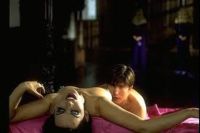
American dominatrix Tanya Cheex (Guinevere Turner) has arrived in London in a blaze of publicity due to her controversial promotion of the sadomasochistic lifestyle that she has embraced. When she appears at a specialist nightclub she and her stage show are welcomed with open arms there, but for Tory MP Henry Harding (Tom Bell) this is the final straw in the decline of morals in his nation, and he holds a press conference accompanied by Christian and feminist representatives to decry Tanya and her ilk. He promises he will be seeking prosecutions...
The impetus for Preaching to the Perverted was presumably the notorious court case of the nineties where a group of men holding a private orgy of pain where famously their genitals were nailed to bits of wood were taken to court for these acts and jailed, mainly because they made the mistake of recording them on tape leaving the proof for all to see. Or the police to see, at any rate, and many had misgivings about the fact they were severely punished for severely punishing themselves, doing what they wanted to do with their bodies even if it wasn't what the law wanted them to do. The case is mentioned in the press conference scene of this film, so we knew where they were coming from.
So what this actually was turned out to be what they used to dismiss as "special pleading", where an issue was raised that the filmmakers thought was pressing and relevant, and put forward the opinion that something needed to be done to change society's attitudes. The most celebrated of these was the Dirk Bogarde movie Victim, about making homosexuality legal, although others included Sapphire (race relations) and Up the Junction (abortion), all you'll note hailing from that period of British upheaval the sixties which saw a liberalisation in the laws of the land, though the subsequent attitudes may have taken a while longer to get used to for many. Here, the approach was one of comedy.
That was the idea at any rate, but precious few viewers found themselves laughing at a style of humour that seemed very much appealing to the "in crowd" of the BDSM scene, and even then there were a number of those initiates who grumbled at the cartoonish version of their pasttimes rendered here. The production took a lot for granted, as if their mission was set to shock the squares and have the hipper viewers sneering away at those who were not so responsive to transgressive behaviour, not a tone that lent itself to a marked amount of easy laughter. The moralists were drawn in broad strokes, which was perhaps fair as their own arguments were often designed the same way, but the subs and doms were not exactly depicted as anything other than advocates.
That was until the movie lost the courage of its convictions and introduced romance into the mix, strongly hinting that the filmmakers were less forward thinking than they claimed and were more interested in a soft, romcom path to their story. Hardy sends a footsoldier into the fray of Tanya's club world, a young aspiring Parliamentary worker called Peter Emery (Christien Anholt), who poses as a new recruit to the scene to gather information for the prosecution. But hey, what do you know? He finds that it's all consensual, nobody suffers any lasting damage, and for all the piercings and PVC it's basically a good old fashioned romp, as you might have been thinking from the punning names. Once we have this established there is nowhere to go, and the love story where Tanya's heart melts is groaningly conventional. If they had come up with wittier dialogue, or any jokes of quality really, they might have brought entertainment to the table, after all what they show was silly, but take away those trappings and there was nothing new here apart from the right-on message. Music by Magnus and Maya Fiennes.