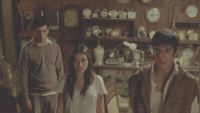
An elderly man (Humberto Yáñez) wanders around a Mexican shopping mall, looking lost as he stumbles from one shop window to the next, seemingly entranced by the mannequins he sees behind the glass. He is told to move on, but succumbs to some kind of ailment that has him collapse and die, whereupon the janitor staff remove the body and mop up the fluid he has left behind. This man's family continue unawares as his two sons, the obedient Alberto (Francisco Barreiro) and the more rebellious Julian (Alan Chávez) tend to his watch mending market stall...
But not for long, as the short fused Julian gets into a fight with a customer (to be fair the man was being fairly insulting) and the stall is banned from the establishment without further notice. There's a streak of desperation running through We Are What We Are, as if to indicate that this is the way many Mexicans are being forced to live what with circumstances being as dire as they are, but it's hard to believe that many of them go to the lengths that this family at the heart of our plot pursue. Although it's not stated outright at the beginning, we can guess that they have a guilty secret, and it's not one which is tolerated by society.
This becomes apparent when Papa is being examined by the mortician and he finds a human finger inside him, evidence that the old man, and indeed his whole family, are not ones given to normal eating habits. This is the strange ritual that the high strung mother (Carmen Beato) constantly refers to, as if this is what will keep them together while also keeping the wolf from the door. However, we can perceive that they are victims of a collective madness, and no matter how they dress up their vile practices with mysticism they are still deeply sick in the head, their argumentative home life testament to the fact that their all-consuming preoccupation with one thing is destroying them.
But thanks to the parents, one of whom is now absent, the children take it upon themselves to continue with their rites, only now there is a tricky proposition of finding a fresh body to prepare. As if that were not bad enough they are extremely choosy, and the mother especially has a peculiar snobbery about who she puts in her mouth, so she admonishes her three kids when they plan to bring home anyone not to her liking. Beggars can't be choosers would be the maxim of this lot you might think, but it evidently takes a very particular dead body for them to be truly satisfied, even if the exact nature of their ceremony remains obscure, as if director Jorge Michel Grau was just as picky about what he included.
This does not stop Alberto and Julian from kidnapping a prostitute as a prospective meal, something their manipulative sister Sabina (Paulina Gaitán) is prepared to go along with but their mother puts paid to their scheme by beating the poor woman to death and then demanding the corpse be returned to where they found her. After about an hour of this you're beginning to think this unsavoury bunch deserve everything they get, and there's not much enjoyment to be had from the relentless squalor and bad tempered exchanges that make up most of the plot. It's all shot in a hazy, moody fashion which adds an extra layer of distance between the audience and the characters, so with no one to latch onto what you're left with is not so much a social commentary and more a tale of a family so obsessed that it drags them down into some kind of hell where nothing else matters. The police are on to them, but the mortician's observation that cannibalism is not uncommon in Mexico is far from reassuring. Excellent strings-based soundtrack from Enrico Chapela.