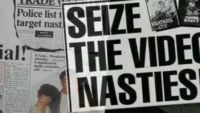
For those too young to remember, the “Video Nasties” furore erupted in early Eighties Britain. Outraged by the easy availability of such hard-gore horror movies as Cannibal Holocaust (1980), I Spit on Your Grave (1978) and The Driller Killer (1979), and their supposed corrupting influence on children, the nation’s censorious moral guardians drew up a list of seventy-two offending titles that were subsequently banned under the 1984 Video Recordings Act. An act whose origins and implications for civil liberties were arguably scarier than any gory, shoddy horror in the nasties themselves.
Video Nasties: Moral Panic, Censorship & Videotape places these events in context. At the dawn of the home video era, in the wake of the Falklands War, widespread urban riots and the general belief propagated by Margaret Thatcher's Tory government that Britain was in moral decline, video nasties became a convenient scapegoat for every evil in society. Such tireless crusaders as Mary Whitehouse and the Daily Mail whipped up a frenzy of mass outrage until action was eventually taken by Peter Kruger, head of the Obscene Publications Squad at Scotland Yard. Tapes were seized from shelves and slung into the furnace in a manner eerily reminiscent of book burnings under the Nazi regime although, as the documentary wryly observes, clueless coppers were as likely to seize such potentially corrupting titles as The Best Little Whorehouse in Texas (1982) (a Burt Reynolds/Dolly Parton musical comedy) and Sam Fuller’s war movie The Big Red One (1980).
Jake West, director of such wannabe nasties as Razor Blade Smile (1998) and Evil Aliens (2002), admirably resists editorialising and lets both sides put forth their arguments. M.P. Graham Bright, the man behind the Video Recordings Act, maintains these films were “evil”, therefore any action resulting in their removal from polite society was justified. In the opposing corner, academic Martin Barker (whose defence of the nasties resulted in his being hounded by the tabloid press) offers the sobering tale of how faked research, a phoney parliamentary committee, and outright theft all played their part in conspiring to push the bill through parliament. Along the way, the sagely Geoffrey Robertson, Q.C. draws parallels with the EC comics scandal of the 1950s, novelist and film critic Kim Newman notes, with no small irony, it was the lurid video covers rather than the content itself that sparked the hysteria (and argues the ad men should bear some responsibility), and The Guardian’s Derek Malcolm reminisces about the farcical (in retrospect) trial that saw video distributor David Hamilton-Grant jailed for releasing an uncut version of Nightmares in a Damaged Brain (1981) - a movie whose real crime was being shite.
Which is of course the problem with the video nasties. Aside from a handful of notable exceptions, the majority were pretty shoddy examples of filmmaking, largely devoid of merit. Even their most ardent defenders here, admit that. Nevertheless, Derek Malcolm rightfully points out liberal aesthetes did themselves a disservice by failing to defend such grotty little items. One of the most pertinent observations comes from Dr. Beth Johnson who winningly raises the issue of class hypocrisy and how M.P.s assume an air of superiority over what they perceive as the "uneducated" masses, unable to discern between fantasy and reality.
Also contributing to the documentary are fans-turned-genre heavy hitters Christopher Smith and Neil Marshall, who reminisce about their formative years watching grubby, third-generation tapes of their favourite nasties. Of course many of the video nasties are now available as pristine, digitally re-mastered DVDs at every high street store, while several have become glossy, big budget, mainstream remakes. The documentary concludes noting how the generation of kids weaned on such scuzzy, disreputable movies were less likely to grow up serial-killers than ardent horror fans, but one could argue West and producer-researcher Marc Morris missed a trick by glossing over the aftermath. In our seemingly, increasingly permissive times, even left-leaning social commentators have worringly begun to suggest that Mary Whitehouse had a point. And then there is the nagging question of whether the easy accessibility of classic nasties, together with the preponderance of extreme horror is being used to sate our appetite and distract us from genuine social outrage. Has the argument been flipped on its head and our hobbies been used against us? The film leaves such pertinent questions unanswered and therefore arguably functions less successfully as a sociological study than an excercise in warped nostalgia.
Nucleus Films three-disc set is an essential purchase for any horror fan. Aside from the documentary itself, the set includes trailers for seventy-two video nasties from Absurd (1981) to Zombie Flesh Eaters (1979), encompassing the thirty-nine titles that were successfully prosecuted and the thirty-three that were initially banned, but then acquitted. Each trailer is prefigured by witty, enlightening commentaries from such genre luminaries as film critics Kim Newman, Stephen Thrower and Alan Jones, Allan Bryce, editor of The Dark Side magazine, TV presenter and horror pinup Emily Booth (who puts in a lively appearance on the menu screen), and academics Dr. Patricia McCormack, Xavier Mendik, Julian Petley and many others. The well-chosen contributors shed some much needed light on some of the more obscure nasties such as I Miss You, Hugs and Kisses (1978) and Frozen Scream (1975).