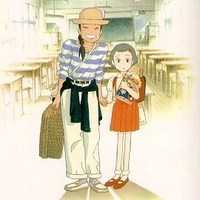
Flashing between 1966 and 1984, Only Yesterday follows office worker Taeko Okajima (voiced by Miki Imai) on her sabbatical at a country farm picking priceless safflowers that are turned into clothing dye. Her journey sparks a series of childhood reminiscences where ten year old Taeko (Yuko Honna) relives joys and frustrations, achievements and embarrassments. Modern day Taeko is smitten with enthusiastic young farmer Toshio (Toshiro Yanagiba) whose positive, affirmative attitude gives her a new outlook on life. But she finds herself torn when Toshio’s family suggest she give up her career and settle down in the country as his wife. At which point ten year old Taeko and her classmates magically appear in the present day, guiding her towards understanding who she is and what she truly wants from life.
Many rank Only Yesterday among the five greatest anime ever made, an animated drama whose warmth, humanity and insight hold up besides the best live action art-house cinema has to offer. Yet in its own gentle, self-effacing way the film is one of the more controversial offerings from Studio Ghibli. Casual viewers may have to adjust their cultural perspectives to accept its deeply Japanese outlook on life, one that emphasises the importance of marriage, implies a successful career and family life are mutually exclusive and stresses acquiescence is noblest of all virtues.
From a western perspective, ten year old Taeko seems like a square peg being hammered into a round hole. She is chastised by her elders for behaviour they deem selfish where a western parent might be more indulgent, robbed of her innocent showbiz dreams on account of their conservative outlook, and briefly labelled “slow-witted” because she struggles with math. Crucially however, modern day Taeko bears not a trace of malice or resentment towards her upbringing. She laughs off her childhood mishaps and gleans a life lesson or two. So is Only Yesterday a simplistic romantic drama masking reactionary conservative ideals? Far from it.
This beautifully observed, low key drama smuggles some pretty radical ideals beneath its serenely traditional surface. Note how Taeko’s mother (Michie Terada), elder sisters Nanako (Yorie Yamashita) and Yaeko (Yuki Minowa) and other female characters are all drawn as warm, sensible and sharp-witted, belying their outwardly docile manner. In contrast to their patriarch, these women are full of life and character. Taeko’s father (Masahiro Itou) is a distant, monosyllabic figure who rarely emerges from behind his newspaper. His authority is absolute, as he figures in key incidents where he denies Taeko her chance to act in a community play and slaps her when she runs outside without shoes, but has little effect in shaping her spirit.
Perception is a major theme. Toshio is more insightful about Taeko’s childhood and helps her reinterpret events in a more positive light. This runs parallel to writer-director Isao Takahata’s desire to challenge city dwellers preconceived notions about nature and country life. As Toshio sagely observes everything city folk sentimentalise as “natural” is actually man made. We shape our environment to serve our needs, but should do so responsibly. Again this feeds through to the idea our unconscious mind are both shaped by and reshape our past, as Taeko realises her childhood has been guiding her towards her dream. Toshio’s perceptive manner makes him more of an ideal partner for Taeko than any preconceived notion about rushing into marriage before she becomes an “old maid” at twenty-seven.
The animation is rendered in lovingly naturalistic detail with sepia-toned backgrounds to evoke a nostalgic mood, eloquent flights of fancy and authentic recreations of vintage posters, kids television shows and pop group performances. Also lookout for a surprise sight gag reference to E.T. the Extraterrestrial (1982). By far Takahata’s greatest achievement however, is his authentic rendering of childhood. Notably in an episode that finds Taeko humiliated when rumours spread a boy from another class has a crush on her. Both kids are mortified and stammer their way through a beautifully observed, awkward courtship, capped by a delightful fantasy where Taeko imagines herself flying through the sky.
Based on a 1987 story by Hotaru Okamoto and Yuko Tone, the 1984 set framing device involving grownup Taeko was conceived by Isao Takahata solely for the film. And yes, the title was drawn from The Carpenters song of the same name that figures in the charming end credit sequence where ten year old Taeko and friends arrive to gently nudge her grownup self towards that life-changing decision. Possibly due to a rights issue, versions of the film available on DVD replace the song with an elegiac Japanese ballad. Personally, I miss The Carpenters (“Tomorrow may be even brighter than today, since I threw my sadness away, only yesterday").