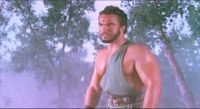
Released by drive-in kings American International Pictures, Goliath and the Dragon was but one of what seem like hundreds of Italian peplum movies - named after the short garment worn by its heroes - released in the wake of Pietro Francisci’s Hercules (1957). Garbled narration barely clarifies the convoluted plot before Goliath (beefy American muscleman Mark Forest), who is confusingly also referred to as “Emilius the Mighty”, climbs down to the “Cave of Horrors” to battle an endearingly hokey, three-headed, fire breathing hell hound and a hairy bat monster. Thus does Goliath (or is it Emilius?) retrieve the fabled “blood diamond” - before it’s nabbed by Leonardo DiCaprio - to appease the gods and vex his mortal enemy the temperamental tyrant Eurystheus (down-on-his-luck Oscar winner Broderick Crawford). In fact Eurystheus is doubly vexed given Goliath’s brother Illus (Sandro Moretti) is in love with Princess Thea (Federica Ranchi), the woman he intends to force into marriage and thereby steal the throne of Thebes. Aided by snake-eyed schemer Tindaro (Giancarlo Sbragia), Eurystheus hatches a plot to drive a wedge between Goliath and his brother. One that, thanks to some ill-chosen conspirators, grows very complicated indeed.
Like a lot of Italian exploitation movies this is a handsome effort. Filmed on sets no doubt left over from bigger budgeted Hollywood epics at Cinecitta, it looks almost as lavish at a fraction of the price. Vittorio Cottafavi may not have been the stylist Mario Bava was but clearly knew how to stage a lurid thrill or two, as when Illus is poised to be crushed underfoot by an elephant or various characters are dangled above a pit of snakes. The production team bedeck the sets with Grecian splendour while the special effects may be variable (e.g. a man in a lousy bear costume) but include some accomplished opticals and a very fine stop-motion animated dragon (a rarity in Italian films). The film also includes several nicely mythopoeic moments, as when the wind carries Thea’s words of warning to her beloved Illus.
Screenwriters Marco Piccolo and the improbably-but-fantastically named Archibald Zounds Jr. add layers of complexity to the serial-like plot by including several conflicted characters. Self-serving slave girl Alcinoe (Wandesa Guida) is so moved by Goliath’s goodness she switches from coveting the Theban throne to becoming one of his closest allies, while Ismene (Gaby André) is torn between her love for Eurystheus and genuine affection for the innocent Thea. Furthermore, Goliath is not quite the clean-cut hero. He disapproves of Illus marrying Thea seeing how her father murdered their parents and goes so far as to tie his brother to a tree.
Moving away from the fascistic overtones of those early peplums spawned by Giuseppe Pastrone’s Cabiria (1913), the Fifties/Sixties sword and sandal films had muscular heroes lending their strength to those that could not fight for themselves. Here the plot takes an interesting turn when a sleazy centaur (Claudio Undari) kidnaps Goliath's dishy wife Dejinara (Leonora Ruffo, a genre regular since the original Hercules) and the gods ignore his pleas for help. Defying the ungrateful gods, Goliath resolves to put family first. The underlining message perhaps being piety is far less important than simple love.