Two escaped convicts struggle through the forest with the guards and dogs hot on their heels. One is Marcel (Henry B. Walthall), whose home is nearby and on reaching it they are welcomed inside by his wife Malita (Rafaela Ottiano). His companion is Paul Lavond (Lionel Barrymore), one of the most powerful bankers in France until he was framed for fraud and the subsequent murder of a nightwatchman, and now he is dead set on clearing his name - or failing that, killing off the three associates who set him up. But once he sees what Marcel had been working on all these years, he cannot believe his eyes...
The idea of shrinking people is one which science fiction has periodically returned to as in The Incredible Shrinking Man or Fantastic Voyage, with various diversions such as Paul McCartney's adventure halfway through Help!, but for some reason horror did not quite embrace the idea in spite of the opportunities the notion raised. Sure, The Incredible Shrinking Man had his cat and spider to do battle with, but to use the little folk as, effectively, "monsters" was not something that was much pursued, making The Devil-Doll something of a novelty: even Dr Cyclops a few years later saw the mad scientist as the antagonist.
This was one of director Tod Browning's last efforts before he retired, disilliusioned, from the profession, and showed some of his inspiration in its staging, working to a script co-written by another disillusioned director, Erich von Stroheim. It was the old revenge motif played out with an eccentric touch, as Lavond discovers Marcel has been endeavouring to reduce his subjects in size, although for what reason other than "make the whole world small" is none too apparent. He has diminished dogs, but then graduates to humans with his wife's maid (Grace Ford), wrapping her in cotton wool and allowing a chemical mist to envelop her.
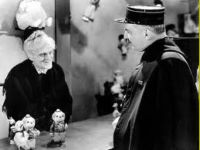
That has the desired effect, but just as Marcel is about to celebrate his breakthrough, he keels over and expires, leaving Malita alone; ah, but not quite alone as Lavond sees great potential for mischief with this set up. Pausing briefly to note the unusual point of a female mad scientist in a genre mostly the domain of males, we are plunged into stage two of the plot, where Lavond heads off to Paris with plans to shrink the men who ruined his life unless they confess. The police have put up wanted posters across the city, but he has a way of confounding them: cross dressing. Looking and sounding like something out of Monty Python, Barrymore is done up like a sweet, silver-haired granny.
Somehow people are fooled, and with Malita he sets up a toy shop as his base of operations. There's also some business about reclaiming stolen jewels, but what is most captivating about this are those special effects sequences. In some parts the joins do show if you're looking for them, but not egregiously so, and as an alternative to camera trickery there are truly impressive sets for the little folk to explore. Definitely the highlight, these parts may not be creepy (though there are those who disagree), but they are a testament to innovative filmmaking as the small assassins wield tiny swords tipped with paralysing poison, although it's worth noting nobody actually dies as part of Lavond's schemes. Add in a would-be tearjerking subplot with Maureen O'Sullivan as the daughter who grew up never knowing her father, and you have a curious, weirdly touching yet inescapably daft chiller. Music by Franz Waxman.