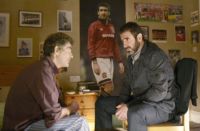
Eric Bishop (Steve Evets) is a Manchester postman who has recently suffered a crisis, which led to him having a short stay in hospital after he deliberately crashed his car while travelling obsessively around a roundabout. He does not feel as if there is anyone he can open up to, and although his friends at work do their best to cheer him up, it's going to take more than a few corny jokes to lift his bone-deep gloom. His second wife doesn't wish to see him and has left him with two teenage stepsons who tolerate him but don't listen to him when he tries to order them about, but now his daughter from his first marriage has a baby herself, a chance might arise...
A chance of what? A chance of Eric alleviating his crushing sense of guilt for leaving his first wife all those years ago, that's what, as for the opening half of the movie, this concerns him more than anything, especially due to his having to face up to meeting her again after such a long time apart. They alternate in babysitting duties as daughter Sam (Lucy-Jo Hudson) studies for her university degree, and naturally Eric must come into contact with ex Lily (Stephanie Bishop), the trauma of which is what sent him crashing his car. She still has not forgiven him, which only makes matters worse, so who can he turn to for guidance in this dark time?
How about the other Eric in the film, Eric Cantona? For it is he, showing up as the postman's imaginary friend after he indulges in his son's hash one night - nobody else can see him, but for the troubled man he is as real as if he were actually in the room. This makes the film part of that little loved subgenre of sports movies, the football film, which usually comes a cropper with proper fans of the game because they tend to watch them with a far more critical eye and leap upon every error or hard to believe event. Looking for Eric ran the risk of alienating everyone who was not a Manchester United follower as well, as it treats postman Eric's hero worship of footballer Eric utterly unironically.
But whether you were interested in football or not, and whether you were a fan of Cantona's team or not, screenwriter Paul Laverty had more up his sleeve than a starry-eyed tribute to a charismatic and controversial player. This was a Ken Loach film after all, and social issues were never far away from his conscience which he brought to bear on the story, although at the start it seems their main worry was how the modern world was making the most vulnerable members of society, the mentally ill among them, suffer with their burdens. We can see that what Eric needs is to get Lily back, but being a flawed character he is standing in the way of his own happiness and contentment, so it takes Cantona and their conversations to work through his self-esteem problems.
However, just when you think you're getting the closest thing to a fluffy romantic comedy Loach ever attempted, the plot takes a right turn into crime territory. Now we have to contend with Eric's stepsons, and one of them, Ryan (Gerard Kearns), who has wound up running with a bad crowd and having to hide a handgun used in a shooting under a loose floorboard in his bedroom. That's also where he keep his stash, which is why his stepdad finds it, and predictably blows up at him, but even then Eric is far less influential, and indeed helpful, than he wants to be. The crime boss uses intimidation to ensure that the postman's family are under his thumb, and things are looking bleak - until Cantona reappears after some absence with a spot of advice. Eric looks to his friends, and in the process discovers he was not as alone as he thought he was and doesn't have to put up with these threats; this could have been a prime example of a cheesy story passing for urban grit, and it may be that too, but the performances and humour, not to mention the compassion, made this one of Loach's best by far.