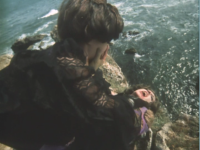
In the early twentieth century, a wealthy landowner died and left his fortune to his two daughters, the uptight Viktorie (Iva Janzurová) and Klara, who was blessed with a sunnier disposition. They were given a house each in the will, which they decided to move into and give up the life of living together that they had previous to their father's death, but something rankled with Viki. Was it that she thought her sister got the better deal, or was it that she was jealous about the way men flocked around Klara while leaving her well alone? Whatever it was, it had twisted her emotions, and tragedy was around the corner...
Morgiana was named after the cat which Viki owns and offers us a point of view as we see through its eyes at its keeper in strange shots, but then strange shots were what this was all about as its creator, adapting a novel by persecuted Russian writer Alexander Grin, set to work on fashioning a tale that was more about the dreamlike atmosphere than the simple relating of a Gothic horror yarn. With eyestraining brightness to the colour, this was no ordinary approach to the material, and the hallucinations the characters went through could just as well been applied to the visuals as director Juraj Herz swooped his camera around the ornate sets and landscapes.
Viki is quite mad, of course, and we can tell that by her grim visage and the way she is hopeless at hiding the darkness in her heart. With the same actress playing both sisters, this was a tour de force for Janzurová, who was otherwise better known in her Czech homeland for her comedy roles, but here proved that there was little a humourist liked better than to emphasise the dramatic and the thrilling in their performances, when allowed. Indeed, if you didn't recognise her and were unaware of the conceit, you could be forgiven for not realising that there was only one woman playing two, such was the effectiveness of her interpretations.
In a way, both Viki and Klara are the same person, two sides of a split personality that one wishes to reunite and the other wishes to destroy in order to prevail. What the black-clad Viktorie does is to get hold of a slow acting poison, slow acting because that way she does not think she will be suspected when Klara keels over and expires thanks to her evil sister's machinations. She actually does catch a glimpse of the potion being applied to her breakfast tea, but doesn't catch on to what is happening until it is too late and downs the brew, leaving her prone to visions that Herz's camera is only to pleased to recreate. So it is that she begins to wane as her sibling grows ever more paranoid.
Although sometimes referred to as the final film of the Czech New Wave, Morgiana isn't a political film like some of its brethren, but does have something to say about repression and how it can warp sensibilities if left unchecked. So maybe in a roundabout way Herz did have something to say about the strict Communist government of the time, but this can just as easily be appreciated as a thriller with horror overtones as Viki is sent spiralling into a morass of her own making, accidentally on purpose poisoning a dog, a little boy and her beloved cat in the process. Not only that but she leaves herself open to blackmail when the poison manufacturer decides to cash in on her plans, not the most sensible thing to do when you're dealing with a psychopath. But Herz leaves a grim joke for his finale when really there's only one dead by the end of this sorry tale, and it's not who you might expect - it's not who they expected either. Music by Lubos Fiser.