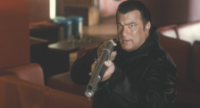
Six months ago, Interpol agent Bobby (Steven Seagal) lost his partner while combating the drug lords who use their ill-gotten gains to fund international terrorism. This incident only causes Bobby to grow more determined to bring down the evildoers, and he has subsequently joined up with a team in Eastern Europe who patrol the narcotics routes there and do their best to stop them in their tracks. However, such misdemeanours are always on his mind, and when one of the top men in drugs trade, Costel (Darren Shahlavi) is responsible for a multiple murder in his district, there's only one thing to do...
You know what that is, don't you? That's right, eat doughnuts! Or that's what Seagal looks as if he's been dedicating his time to here, as Born to Raise Hell was one of those cheap films he made in Eastern Europe, much as his contemporary Jean-Claude Van Damme had done, that in most territories would be going straight to DVD and bypassing the cinemas altogether. On the other hand, this was released in 2010, which saw his highest profile role for some time in the Robert Rodriguez flick Machete, so for many it looked to be not so much a step back as the bigger movie looked like a brief blip in his exposure.
As with many of his other lower budget efforts since the turn of the century, Seagal had a hand in writing the script for this one, in fact his is the sole name credited with the screenplay, so you would have thought that by this time he knew what he wanted from his work and how to best present himself. Yet there was little denying he was getting long in the tooth, and pushing sixty while pretending to beat up men half his age was not exactly the most dignified way of bringing his lead roles to the screen. His adversary this time was minor British action star Shahlavi, who looked as if he could have wiped the floor with Bobby.
But as Seagal was playing the hero, we had to ignore the creaky wheeze that passed for his voice and the frankly portly figure that made his way through the mayhem, and imagine that we were watching a man in his physical prime. Such had been the case for quite some time, and if he wasn't sporting the ponytail in this, the Bela Lugosi-style dyed black hairdo he had instead was no substitute. So if the star had seen better days, what was the appeal? As after all, Seagal still commanded a relatively strong following and his DVDs always made their cash back at a profit for the production, so someone out there must have been lapping these up as if they were going out of fashion.
But then, maybe the plot that sees the traditional good guy best the baddies was never going to go out of fashion, as when we considered John Wayne as a comparison, there was a star who carried on doing the same schtick he had as a much younger man well into his seventies, and he still had the same respect that he ever did in the process. So maybe we should applaud Seagal for whispering his way through the kind of project that had that seen one, seen 'em all air and for continuing to have a career as a leading man in the face of ridicule from some quarters. The action here was strictly by the numbers, a gun fight here, a fast edited fistfight there (fast edited so we can't see Seagal doubled up to catch his breath between takes, perhaps), and there was even a sex scene for Steve where he keeps his clothes on, but the girl with him looks young enough to be his granddaughter. Many would envy Seagal his success, and if you had enjoyed this stuff before, there was no sign here that you wouldn't appreciate more of the same. Music by Michael Neilson.