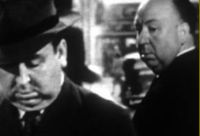
Back in the nineteen-fifties, the world-acknowledged Master of Suspense took to the global stage and put America on the edge of its seat. That man was, of course, Nikita Krushchev, the leader of the Soviet Union, and in the latter part of the decade it looked as if they were going to win the space race, much to the embarrassment of the United States, not to mention the concern that if the Russians could get a satellite into space, how long would it be before weapons were being placed there, pointed at them? But there was one man giving Krushchev a run for his money in the suspense stakes...
And that man was the British film director in Hollywood, the cinematic master Alfred Hitchcock, who used television to increase his profile as the leading filmmaker of his day thanks to interviews and more importantly his weekly thriller series Alfred Hitchcock Presents, which he would introduce in his unmistakable fashion. His style was heavily reliant on gallows humour, which delighted his audiences and made his movie projects come across as that bit more indulgent, as he would appear in their trailers, nudging the viewers into an "it's OK folks, it's only a movie" state of mind, while still placing them in a position of tension.
Why artist Johan Grimonprez thought Hitchcock was the ideal guide through the events leading up the Cuban Missile Crisis of 1962 and beyond, is not immediately clear, however. Building on a short film he made four years previous to this, Double Take uses much archive footage framed around a story from British novelist and critic Tom McCarthy that tells, thanks to impressionist Mark Perry's voiceover, of Hitchcock making The Birds and meeting his own, older, doppelganger in the production office above the set. Hitch recalls that if you ever meet your double you should either kill him, or he will kill you, but he's not sure which, and when he realises this is himself from the year 1980, he can take only one course of action.
As all this is going on, we also get footage of professional Hitchcock impersonator Ron Burrage, who regales us with tales of his second career as a double, and of how he may have been in the same hotel as the great director when he worked as a waiter there. This emphasis on mirror images is what Grimonprez is inviting us to ponder over as he sketches out the relationship between the two superpowers of the second half of the twentieth century, yet although Krushchev did resemble Hitchcock, the parallels between creating real world terror and the safer, fictional kind are strained here. Nevertheless, the documentary maker has himself convinced, even if you might not be so eager to go along with it.
Yet as you watch Double Take, the personality of its subject is what saves it from being a purely academic conceit, because Hitchcock was such a fascinating celebrity. The clips we see of him dryly making his macabre jokes are superbly edited together - this may be nothing more than an eighty minute montage, but it's very well constructed, so that you can almost accept Grimonprez's playing about with his image. Accompanying this are a selection of coffee adverts, taking the absurdly aggressive hard sell to vulnerable housewives of the era, which also act as commentary on how television was taking over, something depicted here as the true source of unease in the homes of the world as they showed the pictures of the Soviets beating the Americans into space, but did not point out the Missile Crisis was sparked by the U.S.A. pushing its luck on how hardline they could be with nuclear weapons. There's much food for thought about the politics and dissemination of fear, even if it's too much of a stretch at times in composition.