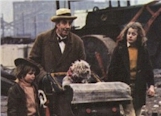
Poverty-stricken young Liz (Donna Mullane) and her little brother Mark (John Chaffey) grow fascinated with Sam (Peter Sellers), an aging street performer whose shabby looks and private melancholy belie his infectious zest for life. With their parents preoccupied trying to earn a crust, the children follow Sam about his daily routine, performing song and dance numbers for pennies alongside his scruffy dog Bella. Liz and Mark slowly discover Sam has much to teach them about life, whilst he in turn warms to them.
This little known gem features what many, including Peter Sellers himself, would argue was his greatest performance. Compared with his admittedly dazzling work in Dr. Strangelove (1964) and Being There (1979) the role of downtrodden, tragicomic music hall performer Sam finds Sellers delivering a far more nuanced characterisation. One by turns tender, acerbic and humane. Sellers went busking for real along the streets of London, as one can tell from the bemused faces of passers by. Alongside a handful of George Formby styled ukulele numbers written by Oliver! (1968) composer Lionel Bart, with additional music by legendary Beatles producer George Martin, Sellers recites comical, yet profound verse illustrating Sam’s defiantly upbeat attitude in the face of adversity.
Writer-director Anthony Simmons adapts his own novel, working from a script penned by Hammer horror veteran Tudor Gates. Simmons had been directing movies since the Fifties, though he wasn’t prolific. He went on to direct a great deal for British television, from Inspector Morse and A Touch of Frost through to Supergran, besides the occasional film including Little Sweetheart (1989), an altogether darker take on childhood. The Optimists comes across in part as a love letter to a London that was gradually disappearing before residents eyes. This is murky Seventies London, where the Swinging Sixties were almost as distant a memory as Sam’s music hall glory days and the camerawork has a rough-hewn, documentary feel that strips sentimentality away in favour of emotional honesty. It is a far from rose-tinted vision with streets full of garbage and half-demolished buildings, but delivers a unique juxtaposition of muck and magic where colourful street performers embody the enduring human spirit.
Even though this is a family film, there is an underlining grit with coarse language and child heroes that are believably smart-alecky whilst still being likeable. Donna Mullane proves an especially fine foil for Sellers with her soul-penetrating stare. Though its meandering plot and deliberate pace left it an acquired taste even back in 1973, the intelligent, challenging script allows Sam and the children to discuss life, death, the past and future. Sellers imbues Sam with quiet dignity, even whilst he quietly confesses to being abandoned by his parents, wife and child. He makes the most of a powerful scene where Sam berates the children’s father (David Daker) for all but ignoring them, though it is a mark of the script’s maturity that one cannot begrudge their parents who are merely struggling to get by. Aside from Sellers’ beguiling song and dance routines there is a charming sequence where the children try on his closet full of fancy dress costumes and a memorable trip to see the newly built tower blocks. Ironically, what is today an eyesore for Londoners marks for our young heroes the promise of a brighter future.